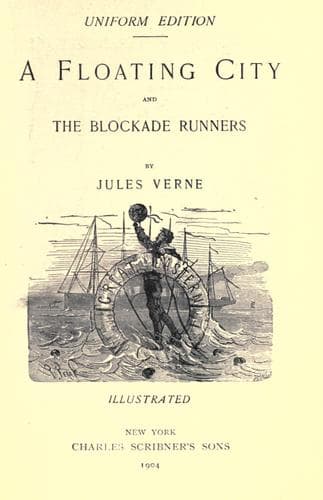
A Floating City, and The Blockade RunnersVerne, Jules
History
A Floating City, and The Blockade Runners
Verne, Jules
Great Eastern (Steamship) -- Fiction; United States -- History -- Civil War, 1861-1865 -- Blockades -- Fiction
“To America, they say, to try and get by chance what he does not care to
work for.”
“Poor Ellen!” murmured the Captain; “where is she now?”
“Perhaps this wretch has abandoned her, or why should she not be on
board?” said Corsican, looking at me.
[Illustration: HE MADE AN ANGRY GESTURE WHICH I ARRESTED.]
This idea crossed my mind for the first time, but I rejected it. No;
Ellen was not, could not be on board; she could not have escaped Dr.
Pitferge’s inquisitive eye. No! she cannot have accompanied Drake on
this voyage!
“May what you say be true, sir!” replied Captain Corsican; “for the
sight of that poor victim reduced to so much misery would be a terrible
blow to Fabian: I do not know what would happen, for Fabian is a man who
would kill Drake like a dog. I ask you, as a proof of your friendship,
never to lose sight of him; so that if anything should happen, one of us
may be near, to throw ourselves between him and his enemy. You
understand a duel must not take place between these two men. Alas!
neither here nor elsewhere. A woman cannot marry her husband’s murderer,
however unworthy that husband may have been.”
I well understood Captain Corsican’s reason. Fabian could not be his own
justiciary. It was foreseeing, from a distance, coming events, but how
is it that the uncertainty of human things is so little taken into
account? A presentiment was boding in my mind. Could it be possible,
that in this common life on board, in this every-day mingling together,
that Drake’s noisy personality could remain unnoticed by Fabian? An
accident, a trifle, a mere name uttered, would it not bring them face to
face? Ah! how I longed to hasten the speed of the steamer which carried
them both! Before leaving Captain Corsican I promised to keep a watch on
our friend, and to observe Drake, whom on his part he engaged not to
lose sight of; then he shook my hand, and we parted.
Towards evening a dense mist swept over the ocean, and the darkness was
intense. The brilliantly-lighted saloons contrasted singularly with the
blackness of the night. Waltzes and ballad songs followed each other;
all received with frantic applause, and even hurrahs were not wanting,
when the actor from T——, sitting at the piano, bawled his songs with the
self-possession of a strolling player.
CHAPTER XIII.
The next day, the 31st of March, was Sunday. How would this day be kept
on board? Would it be the English or American Sunday, which closes the
“bars” and the “taps” during service hours; which withholds the
butcher’s hand from his victim; which keeps the baker’s shovel from the
oven; which causes a suspension of business; extinguishes the fires of
the manufactories; which closes the shops, opens the churches, and
moderates the speed of the railway trains, contrary to the customs in
France? Yes, it must be kept thus, or almost thus.
Public-domain text, read in full here on John Shaqi.
Reviews
Reviews
No reviews yet
Be the first to share your thoughts on this work.
Join the Discussion
Join the discussion
Sign in to leave a comment or review.
Sign InorCreate an account