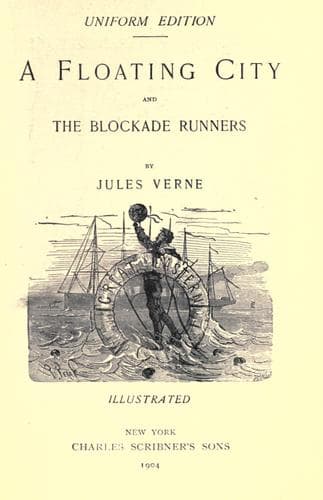
A Floating City, and The Blockade RunnersVerne, Jules
History
A Floating City, and The Blockade Runners
Verne, Jules
Great Eastern (Steamship) -- Fiction; United States -- History -- Civil War, 1861-1865 -- Blockades -- Fiction
The Mersey, like the Thames, is only an insignificant stream, unworthy
the name of river, although it falls into the sea.
It is an immense depression of the land filled with water, in fact
nothing more than a hole, the depth of which allows it to receive ships
of the heaviest tonnage, such as the “Great Eastern,” to which almost
every other port in the world is closed. Thanks to this natural
condition, the streams of the Thames and the Mersey have seen two
immense commercial cities, London and Liverpool, built almost at their
mouths, and from a similar cause has Glasgow arisen on the Clyde.
At Prince’s Landing-Stage, a small tug in the service of the “Great
Eastern” was getting up steam. I went on board and found it already
crowded with workmen and mechanics. As the clock in Victoria Tower
struck seven, the tender left her moorings and quickly ascended the
Mersey with the rising tide.
Scarcely had we started, when I saw on the quay a tall young man, with
that aristocratic look which so distinguishes the English officer. I
thought I recognized in him a friend whom I had not seen for several
years, a captain in the Indian army; but I must have been mistaken, for
Captain Mac Elwin could not have left Bombay, as I ought to have known,
besides Mac Elwin was a gay, careless fellow, and a jovial companion,
but this person, if he resembled him in feature, seemed melancholy, and
as though burdened with a secret grief. Be it as it may, I had not time
to observe him more closely, for the tender was moving rapidly away, and
the impression founded on this resemblance soon vanished from my mind.
The “Great Eastern” was anchored about three miles up the river, at a
depth equal to the height of the tallest houses in Liverpool. She was
not to be seen from Prince’s Stage, but I caught a glimpse of her
imposing bulk from the first bend in the river.
One would have taken her for a small island, hardly discernible in the
mist. She appeared with her bows towards us, having swung round with the
tide; but soon the tender altered her course, and the whole length of
the steam-ship was presented to our view; she seemed what in fact she
was—enormous! Three or four colliers alongside were pouring their
cargoes of coal into her port-holes. Beside the “Great Eastern,” these
three-mast ships looked like barges; their chimneys did not even reach
the first line of light-ports in her hull; the yards of their
gallant-sails did not come up to her bulwarks. The giant could have
hoisted these ships on its davits like shore-boats.
Meanwhile the tender approached the “Great Eastern,” whose chains were
violently strained by the pressure of the tide, and ranged up to the
foot of an immense winding staircase, on the larboard side. In this
position the deck of the tender was only on a level with the load
water-line of the steam-ship, to which line she would be depressed when
in full cargo, and which still emerged two yards.
Public-domain text, read in full here on John Shaqi.
Reviews
Reviews
No reviews yet
Be the first to share your thoughts on this work.
Join the Discussion
Join the discussion
Sign in to leave a comment or review.
Sign InorCreate an account