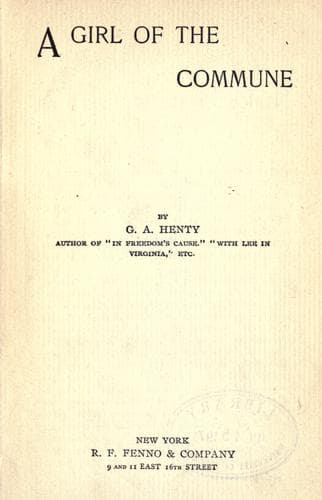
Paris (France) -- History -- Commune, 1871 -- Fiction
He got up, went to the stables, and unchained the dogs, who leapt round
him in wild delight, for the time of late had been as dull for them as
for him; told one of the stable boys to go to the house and say that he
would not be back to lunch, and then went for a twenty mile walk over
the hills, and returned somewhat tired with the unaccustomed exertion,
but with a feeling of buoyancy and light-heartedness such as he had not
experienced for a long time past. For the next week he remained at home,
and then feeling too restless to do so any longer, went to town, telling
Mr. Brander to let him know as soon as the committee, that had already
commenced its investigations into the real state of the bank's affairs,
made their first report.
The lawyer was much puzzled over Cuthbert's manner. It seemed to him
utterly impossible that anyone should really be indifferent to losing a
fine estate, and yet he could see no reason for Cuthbert's assuming
indifference on so vital a subject unless he felt it. He even discussed
the matter with his wife.
"I cannot understand that young Hartington," he said; "most men would
have been completely crumpled up at the news I gave him, but he took it
as quietly as if it had been a mere bagatelle. The only possible
explanation of his indifference that I can think of is that he must have
made some low marriage in London, and does not care about introducing
his wife to the county; it is just the sort of thing that a man with his
irregular Bohemian habits might do--a pretty model, perhaps, or some
peasant girl he has come across when out sketching."
"He never did care particularly about anything," Mrs. Brander said, "and
it may be he is really glad to get away from the country."
"That would be possible enough if he had a good income in addition to
Fairclose, but all that he will have is that five thousand that came to
him from his mother, and I should say he is likely enough to run through
that in a couple of years at the outside, and then where will he be?"
"I can't think, Jeremiah, how you ever permitted his father to do such a
mad thing as to take those shares."
"I know what I am doing, my dear, don't you worry yourself about that.
You have been wanting me for a very long time to give up business and
go into the country. How would Fairclose suit you?"
"You are not in earnest," she exclaimed, with an excitement very unusual
to her. "You can't mean that?"
"I don't often say what I don't mean, my dear, and if Fairclose comes
into the market, more unlikely things than that may come to pass; but
mind, not a word of this is to be breathed."
"And do you really think it will come into the market?" she asked.
"As certain as the sun will rise to-morrow morning. We only held our
first meeting to-day, but that was enough to show us that the directors
ought all to be shut up in a lunatic asylum. The affairs of the bank are
in a frightful state, simply frightful; it means ruin to every one
concerned."
Public-domain text, read in full here on John Shaqi.
Reviews
Reviews
No reviews yet
Be the first to share your thoughts on this work.
Join the Discussion
Join the discussion
Sign in to leave a comment or review.
Sign InorCreate an account