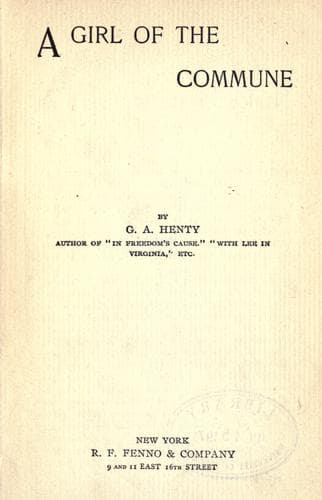
Paris (France) -- History -- Commune, 1871 -- Fiction
"Then he said more seriously, 'I would rather it should be so than that
I should outgrow my strength and become a confirmed invalid. I have
enjoyed my life and have done my best to do my duty as a landlord and as
a magistrate. I am as prepared to die now as I should be twenty years
on. I have been rather a lonely man since I lost my wife. Cuthbert's
ways are not my ways, for he likes life in London, cares nothing for
field sports. But we can't all be cast in one groove, you know, and I
have never tried to persuade him to give up his life for mine, why
should I? However, though I wish you to tell no one else, I should be
glad if you will call on Brander and ask him to drive over. I made my
will years ago, but there are a few matters I should like to talk over
with him.'"
"This is sad, indeed," the lawyer said, sympathetically. "The
Squire--everyone about here calls him the Squire, you know, though there
are men with broader acres than his in the neighborhood--will be
terribly missed. Dear, dear, it will make a sad gap indeed: how long do
you think he is likely to last?"
"He might go at any moment, Brander; but as he has rallied from this
shock it may be some little time before he has another. I should give
him perhaps a couple of months. By the way, I think his son ought to be
informed of it."
"I will ask him about it," the lawyer said. "Of course Cuthbert ought
to know, but may be the Squire will keep it entirely to himself. I
should say there is nothing that would upset him more than the thought
of being fretted over, and I am not sure that he is not right. Of course
I shall drive over there this afternoon."
After Dr. Edwards had left, Jeremiah Brander sat for a long time in deep
thought. Once the clerk came in to ask for instructions about a deed
that he was drawing up, but he waved him away impatiently. "Put it
aside," he said, "I cannot see to it just now, I am busy, and not to be
disturbed for the next hour, whoever comes."
It was evidently a difficult problem Jeremiah Brander had to solve. He
took out his bank-book and went through his payments for a long while
back and then went through some bundles of old checks. One of these he
took off the file; it was for the sum of fifteen thousand pounds, made
payable to self.
"It is lucky now," he muttered, "that I drew it, as I didn't want it
known even in the bank what I was putting the money into," then from a
strongbox with the name "J. W. Hartington," he took out a bundle of
documents, many of which were receipts for money signed by the Squire,
carefully examined the dates and amounts, and put them down on a piece
of paper.
"There would be no difficulty about the signature," he said; "none
whatever; a child could imitate it."
Public-domain text, read in full here on John Shaqi.
Reviews
Reviews
No reviews yet
Be the first to share your thoughts on this work.
Join the Discussion
Join the discussion
Sign in to leave a comment or review.
Sign InorCreate an account