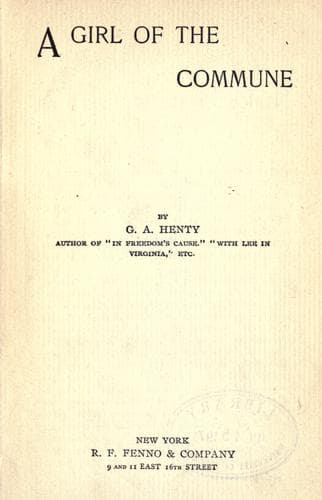
Paris (France) -- History -- Commune, 1871 -- Fiction
Laying one of the sheets before him he wrote on a sheet of foolscap "J.
W. Hartington" a score of times, imitating the somewhat crabbed
handwriting so accurately that even an expert would have had some
difficulty in detecting the difference; he then tore the sheet into
small pieces, put them into the heart of the fire, and watched them
shrivel up to nothing.
"I think it could be done without the slightest risk," he said to
himself, "if one managed the details carefully." Then he sat down and
remained for half an hour without stirring. "It can be done," he said at
last, "it is well worth trying; the property ought to be worth seventy
thousand, but at a forced sale it might go for fifty-five or sixty. I
reckoned last week that I could sell out my stocks for twenty-six
thousand, which, with the fifteen thousand, would bring it over forty,
and I could raise the balance on the estate without difficulty; then
with the rents and what I shall draw for this business, I shall be in
clover." He locked up the papers carefully, put on his hat, and went
across the road to lunch.
There was no trace in his face or manner of the grave matters that had
occupied his thoughts for the last two hours. He was cheerful and even
gay over the meal. He joked Mary about the advancement of women, told
the other girls that he intended that they should take lessons in
riding, gave them an amusing account of the meeting of the Musical
Society he had attended the evening before, and told his wife that she
must dress specially well at the dinner they were going to that evening,
as he had heard that most of the county big-wigs would be there.
Mr. Brander was always pleasant in the bosom of his family, occasionally
sharp words might pass when he and his wife were alone, but when the
girls were present he was always the genial father. There is no better
advertisement for a man than his children's talk. They are unconsciously
his best trumpeters, and when Mr. Brander's name was mentioned and his
many services to his townsmen talked over, the fact that he was one of
the best and kindest of men in his family circle, and that his girls
positively worshipped him, was sure to be adduced as final and clinching
evidence of the goodness of his character.
After lunch he went down to the bank and had a private interview with
the manager.
"By the bye," he said, after a short talk, "I have a client who wants to
buy fifty shares."
The manager glanced sharply at him.
Public-domain text, read in full here on John Shaqi.
Reviews
Reviews
No reviews yet
Be the first to share your thoughts on this work.
Join the Discussion
Join the discussion
Sign in to leave a comment or review.
Sign InorCreate an account