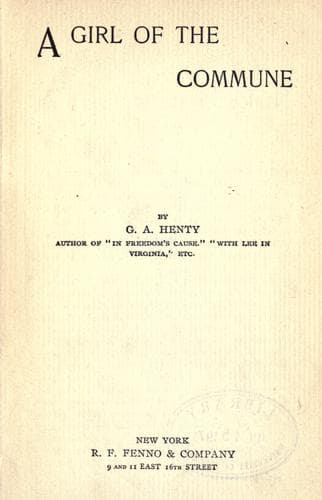
Paris (France) -- History -- Commune, 1871 -- Fiction
"She has no more sentiment in her composition at present," he said to
himself with a laugh that had some bitterness in it, "than a nether
millstone. Her mind is so wrapped up in this confounded fad of hers that
there is no room in it for anything else. I might have been a cousin,
instead of a man she had refused, for any embarrassment or awkwardness
she felt at our sudden meeting. It clearly made no impression at all
upon her. She remembers, of course, that she met me at Newquay. I don't
suppose she has really forgotten that I asked her to be my wife, but it
was a mere incident, and affected her no more than if I had asked her to
buy a picture and she had refused. I wish to goodness I had not met her
again. I had got fairly over it, and was even beginning to wonder how I
ever could have wanted to marry anyone so different in every way from
the sort of woman I fancied I should have fallen in love with. How
foolish of her coming over to Paris at this time. Well, I daresay it has
all saved a lot of trouble. I suppose at that time Brander would have
been delighted at the prospect, but it would have been a very different
thing after the failure of the bank. I don't think he would have made a
pleasant father-in-law under the present circumstances. He is an old
fox. I always thought so, and I think so more than ever now. It has been
a queer affair altogether. I wonder what Mary thinks of it all. I
suppose she will talk to me about it to-morrow afternoon. By the way, I
have to go this evening with Rene and the others to be sworn in or
attested, or whatever they call it, at the Mairie. Their report as to
the officers is satisfactory. I have heard that Longfranc was an
excellent officer before he came into some money, cut the army and took
up art. I have no doubt he will make a good major, and he understands
the men better than most army men would do. They say the Colonel is a
good man, too, and was very popular with his regiment before he retired
from the service."
CHAPTER VI.
On inquiry of the concierge at No. 15 Avenue de Passy, Cuthbert was
informed that Madame Michaud lived on the third floor. On ascending and
ringing the bell the door was opened by an elderly servant.
"I have called to see Mademoiselle Brander, is she at home?"
"She is, sir."
"Would you give her my card, if you please?"
"Mademoiselle is expecting you," the servant said, and led the way at
once into a sitting-room.
Public-domain text, read in full here on John Shaqi.
Reviews
Reviews
No reviews yet
Be the first to share your thoughts on this work.
Join the Discussion
Join the discussion
Sign in to leave a comment or review.
Sign InorCreate an account