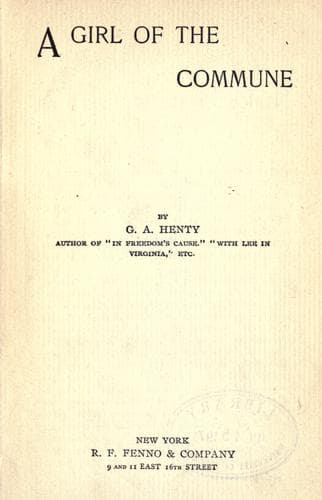
Paris (France) -- History -- Commune, 1871 -- Fiction
It was of the usual type of such room--of good size but bare, with
bee's-waxed flooring, plainly frescoed walls, and a ceiling colored gray
and bordered with painted arabesques. Two or three small rugs relieved
the bareness of the floor. An oval table on very thin legs stood in the
middle; the chairs and couch seemed to have been made to match it, and
had an eminently bare and uncomfortable appearance; a vase of flowers
stood on a spindle-legged little table in front of one of the windows
which opened down to the ground. Some colored prints in frames of
stained wood hung on the walls, and some skimpy curtains draped the
windows.
Mary Brander was seated with a writing-pad on her knee at the window
unoccupied by the vase and its support. She put the writing-pad and a
book, evidently a large diary, down on the floor.
"You are punctual to the minute, Mr. Hartington. I should never have
credited you with that virtue."
"Nor with any other virtue, I imagine, Miss Brander," he said, with a
smile.
"Oh, yes, I do. I credit you with numbers of them. Now draw that chair
up to the window--it is not comfortable, but it is the best of them--and
let us talk. Now, in the first place you don't know how sorry, how
dreadfully sorry I have been about what has happened at home. I was
shocked, indeed, at the news of the sudden death of your dear father. He
was always so kind when he came to see us, and I liked him so much, I
felt for you deeply. It must have been an awful shock for you. I heard
it a few days after I got to Dresden. Then came the other news about
that terrible failure and its consequences. It seemed too shocking
altogether that you should have lost the dear old place, but I do think
I was most shocked of all when I heard that my father had bought it.
Somehow it did not seem to be right. Of course it must have been, but it
did not seem so to me. Did it to you, Cuthbert?" and she looked at him
wistfully.
"I have no doubt it was all right," he said, "and as it was to be sold,
I think I preferred it should be to your father rather than anybody
else. I believe I rather liked the thought that as it was not to be my
home it would be yours."
She shook her head.
"It does not seem to me to be natural at all, and I was miserable all
the time I was there the other day."
"Your father respected my wishes in all respects, Mary. I believe he
kept on all the old servants who chose to stay. He promised me that he
would not sell my father's hunters, and that no one should ride them,
but that they should be pensioners as long as they lived; and the same
with the dogs, and that at any time, if I moved into quarters where I
could keep a dog or two, he would send up my two favorites to me."
Public-domain text, read in full here on John Shaqi.
Reviews
Reviews
No reviews yet
Be the first to share your thoughts on this work.
Join the Discussion
Join the discussion
Sign in to leave a comment or review.
Sign InorCreate an account