A Greek-English Lexicon to the New TestamentGreenfield, William
Religion
A Greek-English Lexicon to the New Testament
Greenfield, William
Bible. New Testament -- Dictionaries -- English; Greek language, Biblical -- Dictionaries -- English
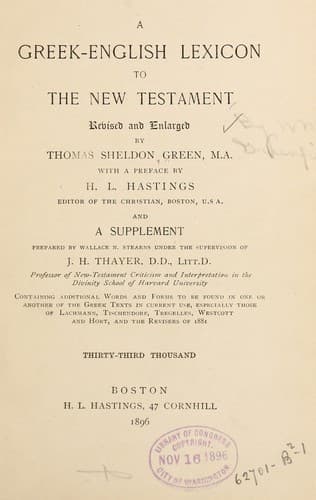
A
Greek–English Lexicon
to
The New Testament
Revised and Enlarged
by
Thomas Sheldon Green
with a preface by
H. L. Hastings
Editor of the Christian, Boston, U.S.A.
and
A Supplement
Prepared by Wallace N. Stearns
Under The Supervision of
J. H. Thayer, D.D., Litt.D.
Professor of New-Testament Criticism
and Interpretation in the
Divinity School of Harvard University
Containing Additional Words and Forms to be found in one or
another of the Greek Texts in current use, especially those
of Lachmann, Tischendorf, Treglles, Westcott
and Hort, and the Revisers of 1881
THIRTY-THIRD THOUSAND
Boston
H. L. Hastings, 47 Cornhill
1896
Copyright, 1896
Boston, Mass, U.S.A.
H. L. Hastings
Repository Press,
47 Cornhill
Greek-Eng Lexicon–33M–6, '96
Printed in America
PREFACE
The hidden depths both of the wisdom and knowledge of God were
manifest, not only in the revelation of his will contained in the
Scriptures of truth, but in the manner of giving that revelation, and in
the language in which is was given.
Egypt had wisdom, but it was enshrined in hieroglyphics so obscure that
their meaning faded centuries ago from the memory of mankind, and for
many successive ages no man on earth could penetrate their mysteries.
Assyria and Babylon had literature, art, and science; but with a
language written in seven or eight hundred cuneiform signs, some of them
having fifty different meanings, what wonder is it that for more than
two thousand years the language and literature of these nations was
lost, buried, and forgotten? The vast literature of China has survived
the changes of centuries, but the list of different characters, which in
a dictionary of the second century numbered 9353, and in the latest
imperial Chinese Dictionary numbers 43,960,—some of them requiring
fifty strokes of the pencil to produce them,—shows how unfit such a
language must be for a channel to convey the glad tidings of God's
salvation to the poor, the weak, the sorrowful, and to people who cannot
spend ten or twenty years in learning to comprehend the mysteries of the
Chinese tongue.
Who can imagine what would have been the fate of a divine revelation if
the words of eternal life had been enswathed in such cerements as these?
Public-domain text, read in full here on John Shaqi.
Reviews
Reviews
No reviews yet
Be the first to share your thoughts on this work.
Join the Discussion
Join the discussion
Sign in to leave a comment or review.
Sign InorCreate an account