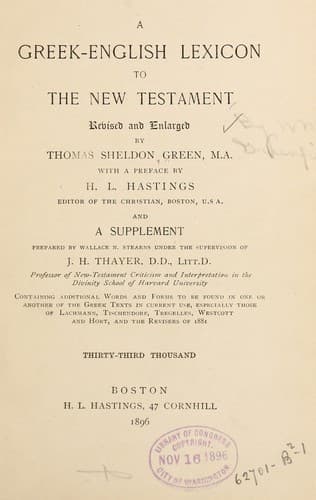
A Greek-English Lexicon to the New TestamentGreenfield, William
Religion
A Greek-English Lexicon to the New Testament
Greenfield, William
Bible. New Testament -- Dictionaries -- English; Greek language, Biblical -- Dictionaries -- English
In the wisdom of God, the revelation of his will was given in the Hebrew
tongue, with an alphabet of twenty-two letters, some of which, as
inscribed on the Moabite stone, b.c. 900, are identical in form and
sound with those now used in English books.
This Hebrew alphabet, so simple that a child might learn it in a day,
has never been lost or forgotten. The Hebrew language in which the
Oracles of God were given to man, has never become a dead language.
Since the day when the Law was given to Moses on Mount Sinai, there
never has been a day or hour when the language in which it was written
was not known to living men, who were able to read, write, and expound
it. And the Hebrew is the only language of those ages that has lived to
the present time, preserving the record of a divine revelation, and
being conserved by it through the vicissitudes of conflict, conquest,
captivity, and dispersion; while the surrounding idolatrous nations
perished in their own corruption, and their languages and literature
were buried in oblivion.
In later ages, when the gospel of the Son of God was to be proclaimed to
all mankind, another language was used as a vehicle for its
communication. The bulk of the Israelitish race, through their
captivities and eternal associations, had lost the knowledge of the holy
tongue, and had learned the languages of the Gentiles among whom they
dwelt; and now as their corporate national existence was to be
interrupted, and they were to be dispersed among the peoples of the
earth, the Hebrew language was not a fit channel for conveying this
revelation to the Gentile world. Hence the same wise Providence which
chose the undying Hebrew tongue for the utterances of the prophets,
selected the Greek, which was at that time, more nearly than any other,
a universal language, as the medium through which the teachings of the
Saviour and the messages of the apostles should be sent forth to
mankind.
This language, like the Hebrew, has maintained its existence,—though
it has been somewhat changed by the flight of years,—and the modern
Greek spoken in Athens to-day is substantially the Greek of 1800 years
ago.
Public-domain text, read in full here on John Shaqi.
Reviews
Reviews
No reviews yet
Be the first to share your thoughts on this work.
Join the Discussion
Join the discussion
Sign in to leave a comment or review.
Sign InorCreate an account