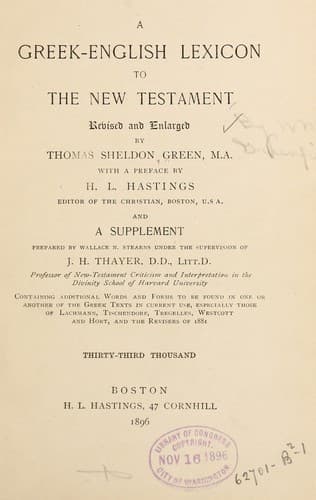
A Greek-English Lexicon to the New TestamentGreenfield, William
Religion
A Greek-English Lexicon to the New Testament
Greenfield, William
Bible. New Testament -- Dictionaries -- English; Greek language, Biblical -- Dictionaries -- English
Μωρός, ά, όν,
foolish, Mat. 7.26; 23.17, 19. 2 Ti. 2.23, et al.;
fr. the Heb. a fool, a wicked, impious man, Mat. 5.22.
Ν, ν, Νῦ
Ναζαρηνός, οῦ, ὁ, v. Ναζωραῖος, ου, ὀ
a Nazarene, an inhabitant of Ναζαρέθ, Nazareth,
Mat. 2.23. Jno. 1.47; et al.
Ναί,
a particle, used to strengthen an affirmation, verily,
Re. 22.20; to make an affirmation, or express an assent,
yea, yes, Mat. 5.37. Ac. 5.8, et al.
Ναός, οῦ, ὁ (ναίω, to dwell)
pr. a dwelling; the dwelling of a deity, a temple,
Mat. 26.61. Ac. 7.48, et al.; used figuratively of
individuals, Jno. 2.19. 1 Co. 3.16, et al.; spc. the
cell of a temple; hence, the Holy Place of the Temple of
Jerusalem, Mat. 23.35. Lu. 1.9, et al.; a model of a temple,
a shrine, Ac. 19.24.
Νάρδος, ου, ὁ, (Heb. נרד)
spikenard, andropogon nardus of Linn., a species of
aromatic plant with grassy leaves and a fibrous root,
of which the best and strongest grows in India; in N.T.,
oil of spikenard, an oil extracted from the plant,
which was highly prized and used as an ointment either
pure or mixed with other substances, Mar. 14.3. Jno. 12.3.
Ναυᾱγέω, ῶ, (ναῦς & ἄγνυμι, to break)
f. ήσω, a.1. ἐναυάγησα,
to make shipwreck, be shipwrecked, 2 Co. 11.25. 1 Ti. 1.19.
Ναύκληρος, ου, ὁ, (ναῦς & κλῆρος)
the master or owner of a ship, Ac. 27.11.
Ναῦς, νεώς, ἡ, (νέω, to swim)
a ship, vessel, Ac. 27.41:
whence
Ναύτης, ου, ὁ,
a shipman, sailor, seaman, Ac. 27.27, 30. Re. 18.17.
Νεᾱνίας, ου, ὁ, (νεάν, idem, fr. νέος)
a young man, youth, Ac. 20.9; 23.17, 18, 22,
used of one who is in the prime and vigour of life,
Ac. 7.58.
Νεᾱνίσκος, ου, ὁ, (fr. same)
a young man, youth, Mar. 14.51; 16.5, et al.;
used of one in the prime of life, Mat. 19.20, 22;
νεαωίσκοι, soldiers, Mar. 14.51.
Νεκρός, ά, όν, (νέκυς, a dead body)
dead, without life, Mat. 11.5; 22.31;
met. νεκρός τινι, dead to a thing, no longer devoted to,
or under the influence of a thing, Ro. 6.11; in the sense
of vain, fruitless, powerless, inefficacious, Ja. 2.17, 20, 26;
morally or spiritually dead, sinful, vicious, impious,
Ro. 6.13. Ep. 5.14; obnoxious to death, mortal, Ro. 8.10;
met. and including the idea of future punishment and misery,
Ep. 2.1, 5. Col. 2.13; causing death and misery, fatal,
having a destructive power, He. 6.1; 9.14, et al.:
whence
Νεκρόω, ῶ,
f. ώσω, a.1. ἐνέκρωσα,
pr. to put to death, kill; in N.T. met. to deaden,
mortify, Col. 3.5; pass. to be rendered impotent,
effete, Ro. 4.19. He. 11.12: (L.G.)
whence
Νέκρωσις, εως, ἡ,
pr. a putting to death; dying, abandonment to death,
2 Co. 4.10; deadness, impotency, Ro. 4.19. L.G.
Νέος, α, ον,
recent, new fresh, Mat. 9.17. 1 Cor. 5.7. Col. 3.13.
He. 12.24; young, youthful, Tit. 2.4, et al.:
whence
Νεοσσός, οῦ, ὁ,
the young of birds, a young bird, youngling, chick, Lu. 2.25.
Νεότης, ητος, ἡ (νέος)
youth, Mat. 19.20. Ac. 26.4, et al.
Νεόφῠτος, ου, ὁ, ἡ, (νέος & φύω)
newly or recently planted; met.
Public-domain text, read in full here on John Shaqi.
Reviews
Reviews
No reviews yet
Be the first to share your thoughts on this work.
Elsewhere in the archive
Join the Discussion
Join the discussion
Sign in to leave a comment or review.
Sign InorCreate an account