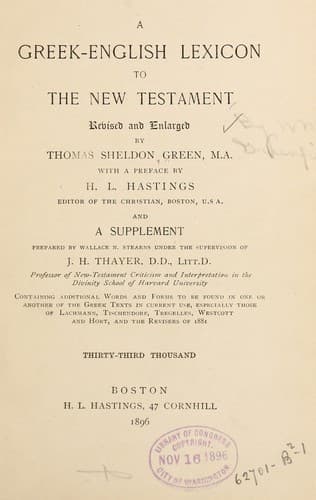
A Greek-English Lexicon to the New TestamentGreenfield, William
Religion
A Greek-English Lexicon to the New Testament
Greenfield, William
Bible. New Testament -- Dictionaries -- English; Greek language, Biblical -- Dictionaries -- English
to deprecate, entreat against, Ac. 25.11. He. 12.19,
to decline receiving, refuse, reject,
1 Ti. 4.7; 5.11. Tit. 3.10. He. 12.25;
to decline, avoid, shun, 2 Ti. 2.23.
Παρακαθίζω, (παρά & καθίζω)
f. ίσω,
to set beside; intrans. to sit by the side of,
sit near, Lu. 10.39.
Παρακαλέω, (παρά & καλέω)
f. έσω,
to call for, invite to come, send for, Ac. 28.20;
to call upon, exhort, admonish, persuade,
Lu. 3.18. Ac. 2.40; 11.23;
to beg, beseech, entreat, implore, Mat. 8.5, 31; 18.29. Mar. 1.40;
to animate, encourage, comfort, console, Mat. 2.18; 5.4. 2 Co. 1.4, 6;
pass. to be cheered, comforted, Lu. 16.25. Ac. 20.12. 2 Co. 7.13, et al.
Παρακαλύπτω, (παρά & καλύπτω)
f. ψω,
to cover over, veil; met. pass. to be veiled from
comprehension, Lu. 9.45.
Παρακαταθήκη, ης, ἡ, (παρακατίθημι, to lay down by, deposit)
a deposit, a thing committed to one's charge, a trust,
1 Ti. 6.20. 2 Ti. 1.14.
Παράκειμαι, (παρά & κεῖμαι)
to lie near, be adjacent;
met. to be at hand, be present, Ro. 7.18, 21.
Παράκλησις, εως, ἡ, (παρακαλέω)
a calling upon, exhortation, incitement, persuasion,
Ro. 12.8. 1 Co. 14.3; hortatory instruction, Ac. 13.15; 15.31;
entreaty, importunity, earnest supplication, 2 Co. 8.4;
solace, consolation, Lu. 2.25. Ro. 15.4, 5. 2 Co. 1.3–7;
cheering and supporting influence, Ac. 9.31;
joy, gladness, rejoicing, 2 Co. 7.13;
cheer, joy, enjoyment, Lu. 6.24.
Παράκλητος, ου, ὁ,
one called or sent for to assist another; an advocate,
one who pleads the cause of another, 1 Jno. 2.1;
genr. one present to render various beneficial service,
and thus the Paraclete, whose influence and operation
were to compensate for the departure of Christ himself,
Jno. 14.16, 26; 15.26; 16.7.
Παρακοή, ῆς, ἡ, (παρακούω)
an erroneous or imperfect hearing; disobdience, Ro. 5.10;
a deviation from obedience, 2 Co. 10.6. He. 2.2.
Παρακολουθεω, ῶ, (παρά & ἀκολουθέω)
f. ήσω,
to follow or accompany closely; to accompany, attend,
characterise, Mar. 16.17; to follow with the thoughts,
trace, Lu. 1.3; to conform to, 1 Ti. 4.6; 2 Ti. 3.10.
Παρακούω, (παρά & ἀκούω)
f. ούσομαι,
to hear amiss, to fail to listen, neglect to obey,
disregard, Mat. 18.17.
Παρακύπτω, (παρά & κύπτω)
f. ψω,
to stoop beside; to stoop down in order to take a view,
Lu. 24.12. Jno. 20.5, 11; to bestow a close and attentive
look, to look intently, to penetrate, Ja. 1.25. 1 Pe. 1.12.
Παραλαμβάνω, (παρά & λαμβάνω)
f. λήψομαι,
pr. to take to one's side, to take, receive to one's self,
Mat. 1.20. Jno. 14.3; to take with one's self,
Mat. 2.13, 14, 20, 21; 4.5, 8; to receive in charge or
possession, Col. 4.17. He. 12.28; to receive as a matter
of instruction, Mar. 7.4. 1 Co. 11.23; 15.3; to receive,
admit, acknowledge, Jno. 1.11. 1 Co. 15.2. Col. 2.6;
pass. to be carried off, Mat. 24.40, 41. Lu. 17.34–36.
Παραλέγομαι, (παρά & λέγω)
to sail by, coast along, Ac. 27.8, 13.
Παράλιος, ιου, ὁ, ἡ, (παρά & ἅλς)
Public-domain text, read in full here on John Shaqi.
Reviews
Reviews
No reviews yet
Be the first to share your thoughts on this work.
Elsewhere in the archive
Join the Discussion
Join the discussion
Sign in to leave a comment or review.
Sign InorCreate an account