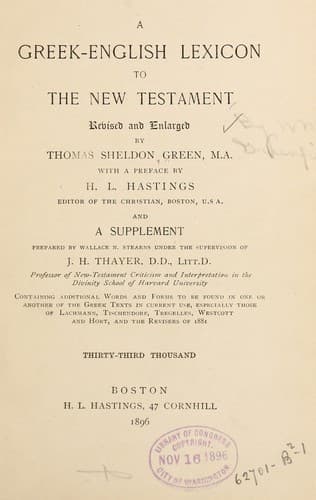
A Greek-English Lexicon to the New TestamentGreenfield, William
Religion
A Greek-English Lexicon to the New Testament
Greenfield, William
Bible. New Testament -- Dictionaries -- English; Greek language, Biblical -- Dictionaries -- English
adjacent to the sea, maritime; ἡ παράλιος, sc. χώρα,
the sea-coast, Lu. 6.17.
Παραλλᾰγή, ῆς, ἡ, (παραλλάσσω, to interchange)
a shifting, mutation, change, Ja. 1.17.
Παραλογίζομαι, (παρά & λογίζομαι)
f. ίσομαι,
to misreckon, make a false reckoning; to impose upon,
deceive, delude, circumvent, Col. 2.4. Ja. 1.22.
Παραλυτικός, ή, όν,
paralytic, palsied, Mat. 4.24; 8.6; 9.2, 6, et al.:
from
Παραλύω, (παρά & λύω)
f. ύσω,
to unloose from proper fixity or consistency of substance;
to enervate or paralyse the body or limbs; pass. to be enervated
or enfeebled, He. 12.12; pass. part. παραλελυμένος, paralytic,
Lu. 5.18, 24, et al.
Παραμένω,
f. μενῶ,
to stay beside; to continue, stay, abide, 1 Co. 16.6. He. 7.23;
met. to remain constant in, persevere in, Ja. 1.25.
Παραμυθέομαι, οῦμαι,(παρά & μυθέομαι, to speak, fr. μῦθος)
f. ήσομαι,
to exercise a gentle influence by words; to soothe, comfort,
console, Jno. 11.19, 31. 1 Th. 5.14; to cheer, exhort, 1 Th. 2.11:
whence
Παραμυθία, ας, ἡ,
comfort, encouragement, 1 Co. 14.3.
Παραμύθιον, ίου, τό,
gentle cheering, encouragement, Ph. 2.1.
Παρανομέω, ῶ, (παρά & νόμος)
f. ησω,
to violate or transgress law, Ac. 23.3:
whence
Παρανομία, ας, ἡ,
violation of law, transgression, 2 Pe. 2.16.
Παραπικραίνω, (παρά & πικραίνω)
f. ανῶ, a.1. παρεπίκρᾱνα,
pr. to incite to bitter feelings; to provoke;
absol. to act provokingly, be refractory, He. 3.16: (S.)
whence
Παραπικρασμός, οῦ, ὁ,
exacerbation, exasperation, provocation; contumacy,
rebellion, He. 3.8, 15. S.
Παραπίπτω, (παρά & πίπτω)
f. πεσοῦμαι, a.2. παρέπεσον,
pr. to fall by the side of; met. to fall off or away from,
make defection from, He. 6.6.
Παραπλέω, ῶ, (παρά & πλέω)
f. εύσομαι,
to sail by or past a place, Ac. 20.16.
Παραπλύσιος, ου, ὁ, ἡ, τό, -ον, (παρά & πλησίος, near)
pr. near alongside; met. like, similar; neut. παραπλήσιον,
adverbially, near to, with a near approach to, Ph. 2.27:
whence
Παραπλησίως,
adv. like, in the same or like manner, He. 2.14.
Παραπορεύομαι,(παρά & πορεύομαι)
f. εύσομαι,
to pass by the side of; to pass along,
Mat. 27.39. Mar. 11.20; 15.29, et al.
Παράπτωμα, ατος, τό, (παραπίπτω)
pr. a stumbling aside, a false step; in N.T.,
a trespass, fault, offence, transgression,
Mat. 6.14, 15; 11.25, 26, Ro. 4.25, et al.;
a fall, defalcation in faith, Ro. 11.11, 12. L.G.
Παραῤῥέω, (παρά & ῥέω)
f. ῥεύσομαι, a.2. παρεῤῥύην,
to flow beside; to glide aside from;
to fall off from profession, decline from steadfastness,
forefeit faith, He. 2.1.
Παράσημον, ου, τό, (παρά & σῆμα)
a distinguishing mark; an ensign or device of a ship,
Ac. 28.11.
Παρασκευάζω, (παρά & σκευάζω)
f. άσω,
to prepare, make ready, 2 Co. 9.2, 3; mid. to prepare one's self,
put one's self in readiness, Ac. 10.10. 1 Co. 14.8.
Παρασκευή, ῆς, ἡ,
a getting ready, preparation; in N.T., preparation for a feast,
day of preparation, Mat. 27.62.
Public-domain text, read in full here on John Shaqi.
Reviews
Reviews
No reviews yet
Be the first to share your thoughts on this work.
Elsewhere in the archive
Join the Discussion
Join the discussion
Sign in to leave a comment or review.
Sign InorCreate an account