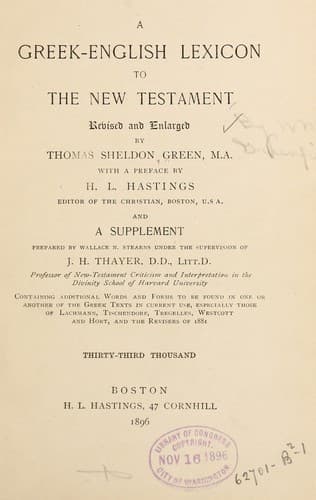
A Greek-English Lexicon to the New TestamentGreenfield, William
Religion
A Greek-English Lexicon to the New Testament
Greenfield, William
Bible. New Testament -- Dictionaries -- English; Greek language, Biblical -- Dictionaries -- English
Mar. 15.42, et al.
Παρατείνω, (παρά & τείνω)
to extend, stretch out; to prolong, continue, Ac. 20.7.
Παρατηρέω, ῶ, (παρά & τηρέω)
f. ήσω,
to watch narrowly, Ac. 9.24; to observe or watch insidiously,
Mar. 3.2. Lu. 6.7; 14.1; 20.20, to observe scrupulously,
Ga. 4.10;
whence
Παρατήρησις, εως, ἡ,
careful watching, intent observation, Lu. 17.20. L.G.
Παρατίθημι, (παρά & τίθημι)
f. παραθήσω,
to place by the side of, near; to set before,
Mar. 6.41; 8.6, 7. Lu. 9.16;
met. to set or lay before, propound, Mat. 13.24, 31;
to inculcate, Ac. 17.3;
to deposit, commit to the charge of, intrust, Lu. 12.48; 23.46;
to commend, Ac. 14.23.
Παρατυγχάνω, (παρά & τυγχάνω)
f. τεύξομαι, a.2. παρέτυχον,
to happen, to chance upon, chance to meet, Ac. 17.17.
Παραυτίκα, (παρά & αὐτίκα)
adv. instantly, immediately; ὁ, ἡ, τὸ παραυτίκα,
momentary, transient, 2 Co. 4.17.
Παραφέρω, (παρά & φέρω)
f. οίσω, a.2. παρήνεγκον
to carry past; to cause to pass away, Mar. 14.36. Lu. 22.42;
pass. to be swept along, v.r. Jude 12; to be led away, misled,
seduced, v.r. He. 13.9.
Παραφρονέω, ῶ, (παρά & φρονέω)
f. ήσω,
to be beside one's wits; παραφρονῶν, in a foolish style,
2 Co. 11.23:
whence
Παραφρονία, ας, ἡ,
madness, folly, 2 Pe. 2.16. N.T.
Παραχειμάζω, (παρά & χειμάζω)
to winter, spend the winter,
Ac. 27.12; 28.11. 1 Co. 16.6. Tit. 3.12:
whence
Παραχειμασία, ας, ἡ,
a wintering in a place, Ac. 27.12. L.G.
Παραχρῆμα, (παρά & χρῆμα)
adv. forthwith, immediately,
Mat. 21.19, 20. Lu. 1.64, et al.
Πάρδᾰλις, εως, ἡ, (equiv. to πάρδος)
a leopard, or panther, Re. 13.2.
Παρεδρεύω, (πάρεδρος, one who sits by, παρά & ἕδρα)
f. εύσω,
to site near; to attend, serve, v.r. 1 Co. 9.13.
Πάρειμι, (παρά & εἰμι)
to be beside; to be present, Lu. 13.1, et al.;
to be come, Mat. 26.50. Jno. 7.6; 11.28. Col. 1.6, et al.;
to be in possession, He. 13.5. 2 Pe. 1.9, 12;
part. παρών, οῦσα, όν, present, 1 Co. 5.3;
τὸ παρόν, the present time, the present, He. 12.11.
Παρεισάγω, (παρά & εἰσάγω)
f άξω,
to introduce stealthily, 2 Pe. 2.1:
whence
Παρείσακτος, ου, ὁ, ἡ,
clandestinely introduced, brought in stealthily, Ga. 2.4. N.T.
Παρεισδύω, v. δύνω, (παρά & εἰσδύω)
f. δύσω, a.1. παρεισέδῡσα,
to enter privily, creep in stealthily, steal in, Jude 4.
Παρεισέρχομαι, (παρά & εἰσέρχομαι)
a.2. παρεισῆλθον,
to supervene, Ro. 5.20; to steal in, Ga. 2.4.
Παρεισφέρω, (παρά & εἰσφέρω)
f. οίσω, a.1. παρεισήνεγκα,
to bring in beside; to bring into play, superinduce,
exhibit in addition, 2 Pe. 1.5.
Παρεκτός, (παρά & ἐκτός)
adv. without, on the outside; except, Mat. 5.32. Ac. 26.29;
τὰ παρεκτός, other matters, 2 Co. 11.28. S.
Παρεμβολή, ῆς, ἡ,
(παρεμβάλλω, to interpose or insert; παρά & ἐμβάλλω)
an insertion beside, later, a marshalling of an army;
an array of battle, army, He. 11.34; a camp, He. 13.11, 13.
Re. 20.9; a standing camp, fortress, citadel, castle,
Ac.
Public-domain text, read in full here on John Shaqi.
Reviews
Reviews
No reviews yet
Be the first to share your thoughts on this work.
Elsewhere in the archive
Join the Discussion
Join the discussion
Sign in to leave a comment or review.
Sign InorCreate an account