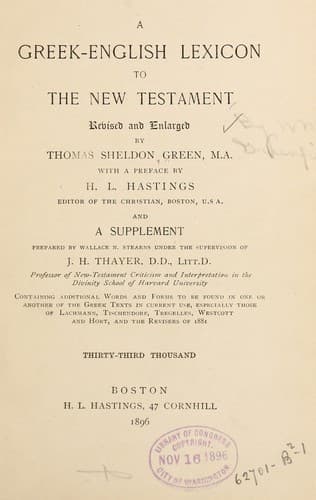
A Greek-English Lexicon to the New TestamentGreenfield, William
Religion
A Greek-English Lexicon to the New Testament
Greenfield, William
Bible. New Testament -- Dictionaries -- English; Greek language, Biblical -- Dictionaries -- English
21.34, 37; 22.24; 23.10, 16, 32.
Παρενοχλέω, ῶ, (παρά & ἐνοχλέω)
f. ήσω,
to superadd molestation; to trouble, harass, Ac. 15.19.
Παρεπίδημος, ου, ὁ, ἡ, (παρά & ἐπίδημος)
residing in a country not one's own, a sojourner, stranger,
He. 11.13. 1 Pe. 1.1; 2.11. L.G.
Παρέρχομαι, (παρά & ἔρχομαι)
f. ελεύσομαι, a.2. παρῆλθον,
to pass beside, pass along, pass by, Mat. 8.28. Mar. 6.48;
to pass, elapse, as time, Mat. 14.15. Ac. 27.9;
to pass away, be removed, Mat. 26.39, 42. Mar. 14.35;
met. to pass away, disappear, vanish, perish, Mat. 5.18; 24.34, 35;
to become vain, be rendered void, Mat. 5.18. Mar. 13.31;
to pass by, disregard, neglect, Lu. 11.42; 15.29;
to come to the side of, come to, Lu. 12.37; 17.7.
Πάρεσις, εως, ἡ, (παρίημι)
a letting pass; remission, forgiveness, pardon, Ro. 3.25.
Παρέχω, (παρά & ἔχω)
f. έξω, a.2. παρέσχον,
to hold beside; to hold out to, offer, present, Lu. 6.29;
to confer, render, Lu. 7.4. Ac. 22.2; 28.2. Col. 4.1;
to afford, furnish, Ac. 16.16; 17.31; 19.24. 1 Ti. 6.17;
to exhibit, Tit. 2.7;
to be the cause of, occasion, Mat. 26.10. Mar. 14.6.
Lu. 11.7, et al.
Παρηγορία, ας, ἡ, (παρηγορέω, to exhort; to console)
exhortation; comfort, solace, consolation, Col. 4.11.
Παρθενία, ας, ἡ,
virginity, Lu. 2.36:
from
Παρθένος, ου, ἡ,
a virgin, maid, Mat. 1.23; 25.1, 7, 11. Ac. 2.9, et al.;
in N.T., also masc., chaste, Re. 14.4.
Παρίημι, (παρά & ἵημι)
f. παρήσω,
to let pass beside, let fall beside; to relax;
pass. p. part. παρειμένος, hanging down helplessly,
unstrung, feeble, He. 12.12.
Παρίστημι, and later also παριστάνω, (παρά & ἵστημι)
f. παραστήσω,
trans. to place beside; to have in readiness, provide, Ac. 23.24;
to present, cause to be present, place a the disposal of,
Mat. 26.53. Ac. 9.41; to present to God, dedicate, consecrate,
devote, Lu. 2.22. Ro. 6.13, 19; to prove, demonstrate, show,
Ac. 1.3; 24.13; to commend, recommend, 1 Co. 8.8;
intrans. p. παρέστηκα, part. παρεστώς, plp. παρειστήκειν, a.2. ταρέστην,
and mid., to stand by or before, Ac. 27.24. Ro. 14.10; to stand by,
to be present, Mar. 14.47, 69, 70; to stand in attendance, attend,
Lu. 1.19; 19.24; of time, to be present, have come, Mar. 4.29;
to stand by in aid, to aid, assist, support, Ro. 16.2.
Πάροδος, ου, ἡ, (παρά & ὁδός)
a way by; a passing by; ἐν παρόδῳ, in passing, by the way, 1 Co. 16.1.
Παροικέω, ῶ, (πάροικος)
f. ήσω,
to dwell beside; later, to reside in a place as a stranger,
sojourn, be a stranger or sojourner, Lu. 24.18. He. 11.9:
whence
Παροικία, ας, ἡ,
a sojourning, temporary residence in a foreign land,
Ac. 13.17. 1 Pe. 1.17. S.
Πάροικος, ου, ὁ, ἡ, (παρά & οἶκος)
a neighbour; later, a sojourner, temporary resident,
stranger, Ac. 7.6, 29. Ep. 2.19. 1 Pe. 2.11.
Παροιμία, ας, ἡ, (πάροιμος, by the road, trite, παρά & οἶμος)
a by-word, proverb, adage, 2 Pe. 2.22; in N.T.,
an obscure saying, enigma, Jno. 16.25, 29; a parable,
Public-domain text, read in full here on John Shaqi.
Reviews
Reviews
No reviews yet
Be the first to share your thoughts on this work.
Elsewhere in the archive
Join the Discussion
Join the discussion
Sign in to leave a comment or review.
Sign InorCreate an account