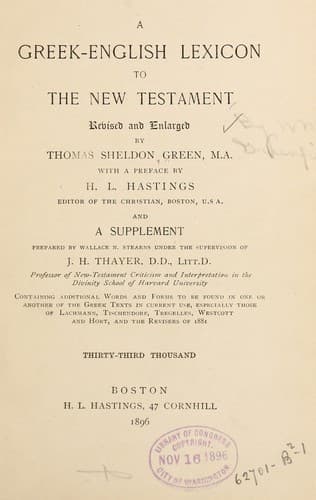
A Greek-English Lexicon to the New TestamentGreenfield, William
Religion
A Greek-English Lexicon to the New Testament
Greenfield, William
Bible. New Testament -- Dictionaries -- English; Greek language, Biblical -- Dictionaries -- English
first in time, in the first place,
Mar. 4.28; 16.9; τὸ πρῶτον, at the first, formerly,
Jno. 12.16; 19.39; first in dignity, importance, &c.,
before all things, Mat. 6.33. Lu. 12.1:
pr. neut. of
Πρῶτος, η, ον, (superl. of πρό, as if contr. from πρότατος)
first in time, order, &c. Mat. 10.2; 26.17;
first in dignity, importance, &c.,
chief, principal, most important,
Mar. 6.21. Lu. 19.47. Ac. 13.50; 16.12;
as an equivalent to the compar. πρότερος,
prior, Jno. 1.15, 30; 15.18; Mat. 27.64;
adverbially, first, Jno. 1.42; 5.4; 8.7.
Πρωτοστάτης, ου, ὁ, (πρῶτος & ἵστημι)
pr. one stationed in the first rank of an army;
a leader; a chief, ringleader, Ac. 24.5. (ᾰ.)
Πρωτοτόκια, ων, τά,
the rights of primogeniture, birthright, He. 12.16: (S.)
from
Πρωτότοκος, ου, ὁ, ἡ, τό, -ον, (πρῶτος & τίκτω)
firstborn, Mat. 1.25. Lu. 2.7. He. 11.28;
in N.T., prior in generation, Col. 1.15;
a firstborn head of a spiritual family, Ro. 8.29. He. 1.6;
firstborn, as possessed of the peculiar privilege of spiritual
generation, He. 12.23.
Πταίω,
f. αίσω, a.1. ἔπταισα,
to cause to stumble; intrans. to stumble, stagger, fall;
to make a false step;
met. to err, offend, transgress, Ro. 11.11. Ja. 2.10; 3.2, bis;
met. to fail of an object, 2 Pe. 1.10.
Πτέρνα, ης, ἡ,
the heel, Jno. 13.18.
Πτερύγιον, ου, τό,
a little wing; the extremity, the extreme point of a thing;
a pinnacle, or apex of a building, Mat. 4.5. Lu. 4.9:
dimin. of
Πτέρυξ, υγος, ἡ, (πτερόν)
a wing pinion, Mat. 23.37. Lu. 13.34, et al.
Πτηνόν, οῦ, τό, (pr. neut. of πτηνός, ή, όν, winged,
fr. πέτομαι, to fly)
a bird, fowl, 1 Co. 15.39.
Πτοέω, ῶ,
f. ήσω, a.1. pass. ἐπτοήθην,
to terrify, affright;
pass. to be terrified, be in consternation, Lu. 21.9; 24.37:
whence
Πτόησις, εως, ἡ,
consternation, dismay, 1 Pe. 3.6.
Πτύον, ου, τό, (πτύω)
a fan, winnowing-shovel, Mat. 3.12. Lu. 3.17.
Πτύρω,
to scare, terrify;
pass. to be terrified, be in consternation, Phi. 1.28.
Πτύσμα, ατος, τό, (πτύω)
spittle, saliva, Jno. 9.6.
Πτύσσω,
f. ξω, a.1. ἔπτυξα,
to fold; to roll up a scroll, Lu. 4.20.
Πτύω
f. ύσω, a.1. ἔπτῠσα,
to spit, spit out, Mar. 7.33; 8.23. Jno. 9.6.
Πτῶμα, ατος, τό, (πίπτω)
a fall; a dead body, carcase, corpse,
Mat. 24.28. Mar. 6.29. Re. 11.8, 9.
Πτῶσις, εως, ἡ, (fr. same)
a fall, crash, ruin, Mat. 7.27;
met. downfall, ruin, Lu. 2.34.
Πτωχεία, ας, ἡ,
begging; beggary; poverty, 2 Co. 8.2, 9. Re. 2.9:
from
Πτωχεύω,
f. εύσω,
to be a beggar; to be or become poor, be in poverty, 2 Co. 8.9:
from
Πτωχός, ή, όν,
reduced to beggary, mendicant; poor, indigent,
Mat. 19.21; 26.9, 11, et al.;
met. spiritually poor, Re. 3.17;
by impl. a person of low condition, Mat. 11.5. Lu. 4.18; 7.22;
met. beggarly, sorry, Ga. 4.9; met. lowly, Mat. 5.3. Lu. 6.20.
Πυγμή, ῆς, ἡ, (πύξ)
the fist; πυγμῇ, together with the fore-arm, or,
with care, carefully, Mar. 7.3.
Πύθων, ωνος, ὁ
Public-domain text, read in full here on John Shaqi.
Reviews
Reviews
No reviews yet
Be the first to share your thoughts on this work.
Elsewhere in the archive
Join the Discussion
Join the discussion
Sign in to leave a comment or review.
Sign InorCreate an account