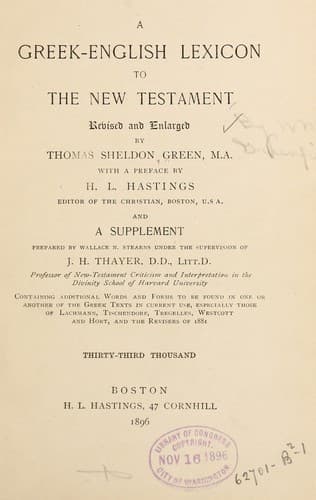
A Greek-English Lexicon to the New TestamentGreenfield, William
Religion
A Greek-English Lexicon to the New Testament
Greenfield, William
Bible. New Testament -- Dictionaries -- English; Greek language, Biblical -- Dictionaries -- English
Python, the name of the mythological serpent slain by Apollo,
thence named the Pythian; later, equivalent to
ἐγγαστρίμαντις, a soothsaying ventriloquist;
πνεῦμα πύθωνος, i.q. δαιμόνιον, μαντικόν, a soothsaying
demon, Ac. 16.16.
Πυκνός, ή, όν,
dense, thick, frequent, 1 Ti. 5.23; πυκνά,
as an adverb, frequently, often, Lu. 5.33;
so the compar. πυκνότερον, very frequently, Ac. 24.26.
Πυκτεύω, (πύκτης, a boxer, fr. πύξ)
to box, fight as a pugilist, 1 Co. 9.26.
Πύλη, ης, ἡ,
a gate, Mat. 7.13, 14. Lu. 7.12. Ac. 12.10, et al.;
τύλαι ᾅδου, the gates of hades, the nether world and its powers,
the powers of destruction, dissolution, Mat. 16.18:
whence
Πυλών, ῶνος, ὁ,
a gateway, vestibule, Mat. 26.71. Lu. 16.20;
a gate, Ac. 14.13. Re. 21.12, 13, 15, 21, 25, et al. L.G.
Πυνθάνομαι,
f. πεύσομαι, a.2. ἐπυθόμην,
to ask, inquire, Mat. 2.4. Lu. 15.26, et al.;
to investigate, examine judicially, Ac. 23.20;
to ascertain by inquiry, understand, Ac. 23.34.
Πῦρ, πυρός, τό,
fire, Mat. 3.10; 7.19; 13.40, et al. freq.;
πυρός, used by Hebraism with the force of an adjective,
fiery, fierce, He. 10.27;
fire used figuratively to express various circumstances
of severe trial, Lu. 12.49. 1 Co. 3.13. Jude 23:
whence
Πυρά, ᾶς, ἡ,
a fire, heap of combustibles, Ac. 28.2, 3.
Πύργος, ου, ὁ,
a tower, Mat. 21.33. Mar. 12.1. Lu. 13.4;
genr. a castle, palace, Lu. 14.28.
Πυρέσσω, v. ττω,
f. ξω,
to be feverish, be sick of a fever, Mat. 8.14. Mar. 1.30:
from
Πυρετός, οῦ, ὁ, (πῦρ)
scorching and noxious heat; a fever, Mat. 8.15. Mar. 1.31, et al.
Πύρῐνος, η, ον, (fr. same)
pr. of fire, fiery, burning; shining, glittering, Re. 9.17.
Πυρόω, ῶ, (fr. same)
f. ώσω,
to set on fire, burn;
pass. to be kindled, be on fire, burn, flame,
Ep. 6.16. 2 Pe. 3.12. Re. 1.15;
met. of anger, to be inflamed, incensed, provoked, 2 Co. 11.29;
of lust, to be inflamed, burn, 1 Co. 7.9;
to be tried with fire, as metals, Re. 3.18.
Πυῤῥάζω,
f. άσω,
to be fiery red, Mat. 16.2, 3: (N.T.)
from
Πυῤῥός, ά, όν, (πῦρ)
of the colour of fire, fiery-red, Re. 6.4; 12.3.
Πύρωσις, εως, ἡ, (πυρόω)
a burning, conflagration, Re. 18.9, 18;
met. a fiery test of trying circumstances, 1 Pe. 4.12.
Πω,
an enclitic particle, yet:
see in μήπω, μηδέπω, οὔπω, οὐδέπω, πώποτε.
Πωλέω, ῶ,
f. ήσω,
to sell, Mat. 10.29; 13.44, et al.
Πῶλος, ου, ὁ, ἡ,
a youngling; a foal or colt,
Mat. 21.2, 5, 7. Mar. 11.2, et al.
Πώποτε, (πω & πότε)
adv. ever yet, ever, at any time, Lu. 19.30. Jno. 1.18, et al.
Πωρόω, ῶ, (πῶρος, a stony concreation)
f. ώσω,
to petrify; to harden;
in N.T., to harden the feelings, Jno. 12.40;
pass. to become callous, unimpressible,
Mar. 6.52; 8.17. Ro. 11.7. 2 Co. 3.14:
whence
Πώρωσις, εως, ἡ,
a hardening; met. hardness of heart, callousness,
insensibility, Mar. 3.5. Ro. 11.25. Ep. 4.18.
Πως,
an enclitic particle, in any way, by any means:
see εἰπως, μήπως.
Πῶς,
adv.
Public-domain text, read in full here on John Shaqi.
Reviews
Reviews
No reviews yet
Be the first to share your thoughts on this work.
Elsewhere in the archive
Join the Discussion
Join the discussion
Sign in to leave a comment or review.
Sign InorCreate an account