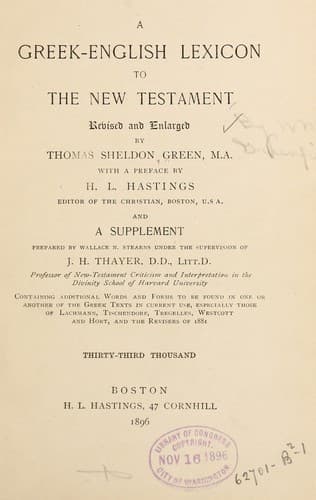
A Greek-English Lexicon to the New TestamentGreenfield, William
Religion
A Greek-English Lexicon to the New Testament
Greenfield, William
Bible. New Testament -- Dictionaries -- English; Greek language, Biblical -- Dictionaries -- English
how? in what manner? by what means? Mat. 7.4; 22.12. Jno. 6.52;
used in interrogations which imply a negative,
Mat. 12.26, 29, 34; 22.45; 23.33. Ac. 8.31;
put concisely for how is it that? how does it come to pass that?
Mat. 16.11; 22.43. Mar. 4.40. Jno. 7.15;
with an indirect interrogation, how, in what manner,
Mat. 6.28; 10.19. Mar. 11.18; put for τί, what?
Lu. 10.26; put for ὡς, as a particle of exclamation, how,
how much, how greatly, Mar. 10.23, 24.
Ρ, ρ, Ῥῶ
Ῥαββι, ὁ indec. (later Heb. רבי fr. רב, which was deemed less honourable)
Rabbi, my master, teacher, doctor,
Mat. 23.7, 8; 26.25, 49, et al.
Ῥαββονί, v. Ῥαββουνί (later Heb. רבן, Aram. with suffix, רבוני)
Rabboni, my master, the highest title of honour in the
Jewish schools, Mar. 10.51. Jno. 20.16.
Ῥαβδίζω,
f. ίσω, a.1. ἐῤῥάβδισα, a.1. pass. ἐῤῥαβδίσθην,
to beat with rods, Ac. 16.22. 2 Co. 11.25:
from
Ῥάβδος, ου, ἡ,
a rod, wand, He. 9.4. Re. 11.1; a rod of correction, 1 Co. 4.21;
a staff, Mat. 10.10. He. 11.21; a sceptre, He. 1.8. Re. 2.27.
Ῥαβδοῦχος, ου, ὁ, (ῥάβδος & ἔχω)
the bearer of a wand of office; a lictor,
serjeant, a public servant who bore a bundle of rods
before the magistrates as insignia of their office,
and carried into execution the sentences they pronounced,
Ac. 16.35, 38.
Ῥᾳδιούργημα, ατος, τό,
(ῥᾳδιουργέω, to do easily, to act recklessly; ῥᾴδιος, easy, & ἔργον)
pr. any thing done lightly, levity; reckless conduct, crime,
Ac. 18.14. L.G.
Ῥαδιουργία, ας, ἡ, (fr. same)
facility of doing any thing; levity in doing;
recklessness, profligacy, wickedness, Ac. 13.10.
Ῥακά,
an Aramaean term of bitter contempt, worthless fellow, Mat. 5.22.
Ῥάκος, εος, τό, (ῥάσσω, ῥήσσω)
a torn garment; a shred or strip of cloth, Mat. 9.16. Mar. 2.21.
Ῥαντίζω, (ῥαίνω, idem)
f. ίσω, a.1. ἐῤῥάντισα, p. pass. ἐῤῥάντισμαι,
to sprinkle, besprinkle, He. 9.13, 19, 21;
met. and by impl. to cleanse by sprinkling, purify,
free from pollution, He. 10.22: (L.G.)
whence
Ῥαντισμός, οῦ, ὁ,
a sprinkling; met. a cleansing, purification, lustration.
He. 12.24. 1 Pe. 1.2. S.
Ῥαπίζω, (ῥαπίς, a rod)
f. ίσω, a.1. ἐῤῥάπισα,
to beat with rods; to strike with the palm of the hand, cuff,
slap, Mat. 5.39; 26.67:
whence
Ῥάπισμα, ατος, τό,
a blow with the palm of the hand, cuff, slap,
Mar. 14.65. Jno. 18.22; 19.3. L.G.
Ῥαφίς, ίδος, ἡ, (ῥάπτω, to sew, sew together)
a needle, Mat. 19.24. Mar. 10.25. Lu. 18.25.
Ῥέδα, v. ῥέδη, ης, ἡ, (Lat., rheda)
a carriage with four wheels for travelling, chariot, Re. 18.13.
Ῥεμφάν, v. Ῥεφάν,
the name of an idol, Ac. 7.43. The original passage,
Amos 5.26, has כיון; the Sept. Ῥαιφάν, the Egyptian name
for the planet Saturn.
Ῥέω,
f. ῥεύσομαι, a.1. ἔῤῥευσα,
to flow, Jno. 7.38.
Ῥηθείς,
part. of ἐῤῥήθνη, a.1. pass. used in connexion
with λέγω, φημί, and εἰπεῖν.
Ῥῆγμα, ατος, τό,
a rent; a crash, ruin, Lu. 6.49:
from
Ῥήγνυμι, v. ῥήσσω,
f. ξω, a.1. ἔῤῥηξα,
Public-domain text, read in full here on John Shaqi.
Reviews
Reviews
No reviews yet
Be the first to share your thoughts on this work.
Elsewhere in the archive
Join the Discussion
Join the discussion
Sign in to leave a comment or review.
Sign InorCreate an account