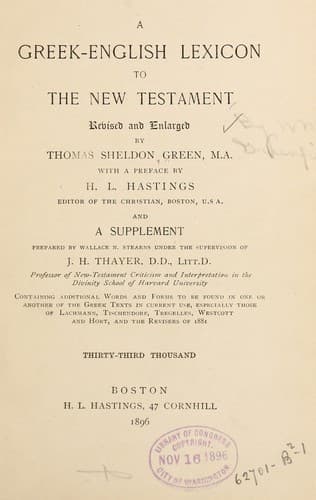
A Greek-English Lexicon to the New TestamentGreenfield, William
Religion
A Greek-English Lexicon to the New Testament
Greenfield, William
Bible. New Testament -- Dictionaries -- English; Greek language, Biblical -- Dictionaries -- English
Ἀνυπόκρῐτος, ου, ὁ, ἡ (ἀ & ὑποκρίνομαι)
unfeigned, real, sincere, Ro. 12.9, et al. L.G.
Ἀνυπότακτος, ου, ὁ, ἡ, (ἀ & ὑποτάσσω)
not subjected, not made subordinate, He. 2.8;
insubordinate, refractory, disorderly, contumacious,
lawless, 1 Ti. 1.9. Tit. 1.6, 10. L.G.
Ἄνω,
adv. above; up, upwards; ὁ, ἡ, τό, ἄνω, that which
is above, higher.
Ἀνώγεον, v. ἀνώγαιον, v. ἀνώγεων, v. ἀνάγειον, ου, τό, (ἄνω & γῆ)
an upper room, or chamber, cœnaculum, Mar. 14.15. Lu. 22.12.
Ἄνωθεν,
adv. of place, from above, from a higher place;
of time, from the first or beginning; again, anew;
with a preporition, the top or upper part, Mat. 27.51.
Ἀνωτερικός, ή, όν,
upper, higher; inland, Ac. 19.1. N.T.
Ἀνώτερος, α, ον, (comp. of ἄνω)
higher, superior; to a higher place, Lu. 14.10; above,
before, He. 10.8. L.G.
Ἄνωφελής, έως, ὁ, ἡ, τό, -ες, (ἀ & ὠφελέω)
useless, unprofitable, mischievous, Tit. 3.9. He. 7.18.
Ἀξίνη, ης, ἡ,
an axe, Mat. 3.10. Lu. 3.9. (ῑ)
Ἄξιος, ία, ιον,
of equal value; worthy, estimable; worthy of, deserving,
either good or evil; correspondent to; comparable to;
suitable, due:
whence
Ἀξιόω, ῶ,
f. ώσω, p. pass. ἠξίωμαι,
to judge or esteem worthy or deserving; to deem fitting,
to require, Ac. 15.38; 28.22.
Ἀξίως,
adv. worthily, suitably, properly, in a becoming manner.
Ἀόρᾱτος, ου, ὁ, ἡ, τό, -ον, (ἀ & ὁράω)
invisible, Ro. 1.20. Co. 1.15, 16, 1 Ti. 1.17. He. 11.27.
Ἀπαγγέλλω, (ἀπό & ἀγγέλλω)
f. γελῶ, a.1. ἀπήγγειλα, a.2. pass ἀπηγγέλην,
to enounce that with which a person is charged, or
which is called for by circumstances; to carry back
word; to report; to declare plainly; to announce
formally.
Ἀπάγχω, (ἀπό & ἄγχω, to compress)
f. άγξω,
to strangle; mid. to choke or strangle one's self,
hang one's self, Mat. 27.5.
Ἀπάγω, (ἀπό & ἄγω)
f. ξω, a.2. ἀπήγαγον, a. 2. pass. ἀπήχθην,
to lead away, conduct; met. to seduce.
Ἀπαίδευτος, ου, ὁ, ἡ, (ἀ & παιδεύω)
uninstructed, ignorant; silly, unprofitable, 2 Ti. 2.23.
Ἀπαίρω, (ἀπό & αἴρω)
f. αρῶ, a.1. pass. ἀπήρθην, subj. ἀπαρθῶ,
to take away; pass. to be taken away; in the sense
of departing, Mat. 9.15. Mar. 2.20. Lu. 5.35.
Ἀπαιτέω, ῶ, (ἀπό & αἰτέω)
f. ήσω,
to demand, require, demand back, Lu. 6.30; 12.20.
Ἀπαλγέω, ῶ, (ἀπό & ἀλγέω, to be in pain, grieve)
f. ήσω, p. ἀπήλγηκα,
pr. to desist from grief; hence, to become insensible
or callous, Ep. 4.19.
Ἀπαλλάσσω, (ἀπό & ἀλλάσσω)
f. ξω, a.1. pass. ἀπηλλάχθην,
to set free, deliver, set at liberty, He. 2.15; to rid
judicially, Lu. 12.58; mid. to leave, depart, remove
from, Ac. 19.12.
Ἀπαλλοτριόω, ῶ, (ἀπό & ἀλλοτριόω, to alienate)
f. ώσω, p. pass. ἀπηλλοτρίωμαι,
to alienate; pass. to be alienated from, be a stranger
to, Ep. 2.12; 4.18. Col. 1.21.
Ἁπαλός, ή, όν,
soft, tender, Mat. 24.32. Mar. 13.28.
Ἀπαντάω, ῶ, (ἀπό & ἀντάω, to meet)
f. ήσω,
to meet, encounter:
whence
Ἀπάντησις, εως, ἡ,
Public-domain text, read in full here on John Shaqi.
Reviews
Reviews
No reviews yet
Be the first to share your thoughts on this work.
Join the Discussion
Join the discussion
Sign in to leave a comment or review.
Sign InorCreate an account