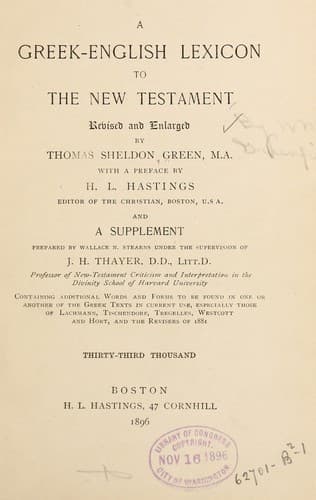
A Greek-English Lexicon to the New TestamentGreenfield, William
Religion
A Greek-English Lexicon to the New Testament
Greenfield, William
Bible. New Testament -- Dictionaries -- English; Greek language, Biblical -- Dictionaries -- English
a meeting, encounter: εἰς ἀπάντησιν, i.q. ἀπαντᾶν,
to meet, Mar. 25.1, 6. Ac. 28.15. 1 Th. 4.17. L.G.
Ἅπαξ,
adv. once; once for all; actually, in fact, Jude 3, 5.
Ἀπαράβᾰτος, ου, ὁ, ἡ, (ἀ & παραβαίνω)
not transient; not to be superseded, unchangeable,
He. 7.24. L.G.
Ἀπαρασκεύαστος, ου, ὁ, ἡ, (ἀ & παρασκευάζω)
unprepared, 2 Co. 9.4.
Ἀπαρνέομαι, οῦμαι, (ἀπό & ἀρνέομαι)
f. ήσομαι, & pass. ἀπαρνηθήσομαι,
to deny, disown; to renounce, disregard.
Ἀπαρτί, (ἀπό & ἄρτι)
adv. from this time, henceforth, Jno. 1.52.
Re. 14.13; forthwith.
Ἀπαρτισμός, ου, ὁ, (ἀπαρτίζω, to perfect, fr. ἀπό & ἄρτιος)
completion, perfection, Lu. 14.28. L.G.
Ἀπαρχή, ῆς, ἡ, (ἀπό & ἀρχή)
pr. the first act of a sacrifice; hence, the first-fruits,
first portion, firstling. Ro. 8.23, et al.
Ἅπας, ασα, αν, (a strengthened form of πᾶς)
all, the whole.
Ἀπατάω, ῶ,
f. ήσω, a.1. pass. ἠπατήθη,
to deceive, seduce into error, Ep. 5.6. 1 Ti. 2.14. Ja. 1.26:
whence
Ἀπάτη, ης, ἡ,
deceit, deception, defusion.
Ἀπάτωρ, ορος, ὁ, ἡ, (ἀ & πατήρ)
pr. without a father, fatherless; hence, independent of
paternal descent, He. 7.3. (ᾰ)
Ἀπαύγασμα, ατος, τό, (ἀπό & αὐγάζω)
an effulgence, He. 1.3. L.G.
Ἀπεῖδον,
subj. ἀπίδω, see ἀφοράω.
Ἀπείθεια, ας, ἡ, (ἀπειθής)
that disposition of mind which will not be persuaded,
which refuses belief and obedience, obstinacy,
contumacy, disobedience, unbelief, Ro. 11.30, 32.
Ep. 2.2; 5.6. He. 4.6, 11. Col. 3.6.
Ἀπειθέω, ῶ,
f. ήσω,
not to suffer one's self to be persuaded; to refuse
belief, disbelieve, be incredulous; to refuse obedience
through unbelief, disobey; refuse belief and obedience,
be contumacious:
from
Ἀπειθής, έος, οῦς, ὁ, ἡ, (ἀ & πείθω)
who will not be persuaded, who refuses belief and
obedience, unbelieving, disobedient, contumacious.
Ἀπειλέω, ῶ,
f. ήσω, a.1. ἠπείλησα,
to threaten, menace, rebuke, Ac. 4.17. 1 Pe. 2.23:
whence
Ἀπειλή, ῆς, ἡ,
threat, commination, Ac. 4.17, 29; 9.1; harshness of
language, Ep. 6.9.
Ἄπειμι, (ἀπό & εἰμί)
f. έσομαι,
to be absent.
Ἄπειμι, (ἀπό & εἶμι, to go)
imperfect, ἀπῄειν,
to go away, depart, A. 17.10.
Ἀπεῖπον,
a.2. act. to tell out; to refuse, forbid;
mid. a.1. ἀπειπάμην, to renounce, disclaim, 2. Co. 4.2.
Ἀπείραστος, ου, ὁ, ἡ, (ἀ & πειράζω)
not having tried, inexperienced, or, untried or,
incapable of being tried, Ja. 1.13. L.G.
Ἄπειρος, ου, ὁ, ἡ, (ἀ & πεῖρα)
unexperienced, unskilful, ignorant, He. 5.13.
Ἀπεκδέχομαι, (ἀπό & ἐκδέχομαι)
f. έξομαι,
to expect, wait or look for, Ro. 8.19, 23, 25.
1 Co. 1.7. Gal. 5.5. Phi. 3.20. He. 9.28. L.G.
Ἀπεκδύομαι, (ἀπό & ἐκδύω)
f. ύσομαι,
to put off, strip, divest, renounce, Col. 2.15; 3.9. (L.G.)
whence
Ἀπέκδῠσις, εως, ἡ,
a putting or stripping off, renunciation, Col. 2.11. N.T.
Ἀπελαύνω, (ἀπό & ἐλαύνω)
f. ελάσω, a.1. ἀπήλᾰσα,
to drive away, Ac. 18.16.
Ἀπελεγμός, οῦ, ὁ, (ἀπελέγχω, to refute, fr. ἀπό & ἐλέγχω)
pr.
Public-domain text, read in full here on John Shaqi.
Reviews
Reviews
No reviews yet
Be the first to share your thoughts on this work.
Join the Discussion
Join the discussion
Sign in to leave a comment or review.
Sign InorCreate an account