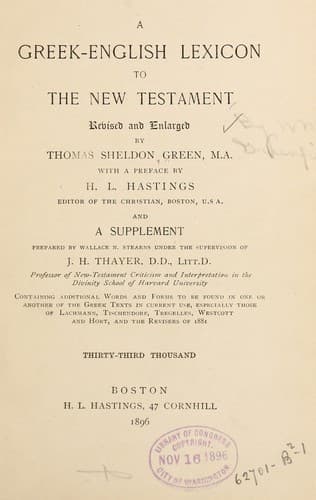
A Greek-English Lexicon to the New TestamentGreenfield, William
Religion
A Greek-English Lexicon to the New Testament
Greenfield, William
Bible. New Testament -- Dictionaries -- English; Greek language, Biblical -- Dictionaries -- English
refutation; by impl. disesteem, contempt, disgrace,
Ac. 19.27. N.T.
Ἀπελεύθερος, ου, ὁ, ἡ, (ἀπό & ἐλεύθερος)
a freed-man, 1 Co. 7.22.
Ἀπελπίζω, (ἀπό & ἐλπίζω)
f. ίσω,
to lay aside hope, despond, despair; also, to hope for
something in return, Lu. 6.35. L.G.
Ἀπέναντι, (ἀπό & ἔναντι)
adv. opposite to, over against, Mat. 21.2; 27.61;
contrary to, in opposition to, against, Ac. 17.7; before,
in the presence of, Mat. 27.24. Ac. 3.16. L.G.
Ἀπέραντος, ου, ὁ, ἡ, (ἀ & πέρας)
unlimited, interminable, endless, 1 Ti. 1.4.
Ἀπερισπάστως, (ἀ & περισπάω)
adv. without distraction, without care or solicitude,
1 Co. 7.35. L.G.
Ἀπερίτμητος, ου, ὁ, ἡ, τό, -ον, (ἀ & περιτέμνω)
pr. uncircumcised; met. obdurate, pertinacious,
Ac. 7.51. L.G.
Ἀπέρχομαι, (ἀπό & ἔρχομαι)
f. ελεύσομαι, a.2. ῆλθον,
to go away, depart; to go forth, pervade, as a rumour;
to arrive at a destination; to pass away, disappear;
in N.T., ἀπέρχομαι ὀπίσω, to follow.
Ἀπέχω, (ἀπό & ἔχω)
f. ἀφέξω,
trans. to have in full what is due or is sought; hence,
impers. ἀπέχει, it is enough; intrans. to be distant,
to be estranged; mid. to abstain from.
Ἀπιστέω, ῶ, (ἀ & πίστις)
f. ήσω,
to refuse belief, be incredulous, disbelieve;
Mar. 16.11, 16. Lu. 24.11, 41. Ac. 28.24; to prove
false, violate one's faith, be unfaithful,
2 Ti. 2.13. Ro. 3.3.
Ἀπιστία, ας, ἡ, (fr. same)
unbelief, want of trust and confidence; a state of
unbelief, 1 Ti. 1.13; violation of faith, perfidy,
Ro. 3.3. He. 3.12, 19.
Ἄπιστος, ου, ὁ, ἡ, τό, -ον, (ἀ & πιστός)
unbelieving, incredulous, without confidence in any one;
violating one's faith, unfaithful, falso, treacherous;
one who has not embraced the Christian faith, an unbeliever,
infidel, pagan; pass. incredible, Ac. 26.8.
Ἁπλόος, όη, όον, contr. οῦς, ῆ, οῦν,
pr. single; hence, simple, uncompounded; sound, perfect,
Mat. 6.22. Lu. 11.34:
whence
Ἁπλότης, ητος, ἡ,
simplicity, sincerity, purity or probity of mind,
Ro. 12.8. 2 Co. 1.12; 11.3. Ep. 6.5. Col. 3.22;
liberality, as arising from simplicity and frankness
of character, 2 Co. 8.2; 9.11, 13.
Ἁπλῶς,
adv. in simplicity; sincerely, really; or, liberally,
bountifully, Ja. 1.5.
Ἀπὸ,
prep. pr. forth from, away from; hence it variously
signifies departure; distance of time or place; avoidance;
riddance; derivation from a quarter, source, or material;
origination from agency or instrumentality.
Ἀποβαίνω, (ἀπό & βαίνω)
f. βήσομαι, a.2. ἀπέβην,
to descend from a ship, disembark, Lu. 5.2. Jno. 21.9;
to become, result, happen, Lu. 21.13. Phi. 1.19.
Ἀποβάλλω, (ἀπό & βάλλω)
f. βαλῶ, a.2. ἀπέβαλον,
to cast or throw off, cast aside, Mar. 10.50.
Ἀποβλέπω, (ἀπό & βλέπω)
f. ψω,
pr. to look off from all other objects and at a single one;
hence, to turn a steady gaze, to look with fixed and earnest
attention, He. 11.26.
Ἀπόβλητος, ου, ὁ, ἡ, τό, -ον, (ἀποβάλλω)
pr. to be cast away; met. to be contemned, regarded as
vile, 1 Ti.
Public-domain text, read in full here on John Shaqi.
Reviews
Reviews
No reviews yet
Be the first to share your thoughts on this work.
Join the Discussion
Join the discussion
Sign in to leave a comment or review.
Sign InorCreate an account