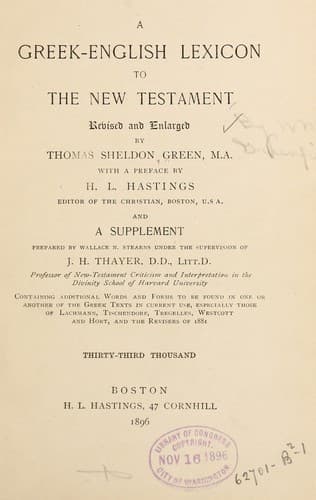
A Greek-English Lexicon to the New TestamentGreenfield, William
Religion
A Greek-English Lexicon to the New Testament
Greenfield, William
Bible. New Testament -- Dictionaries -- English; Greek language, Biblical -- Dictionaries -- English
Ἀπόλαυσις, εως, ἡ, (ἀπολαύω, to obtain a portion of a thing, enjoy)
beneficial participation, 1 Ti. 6.17; enjoyment, pleasure, He. 11.25.
Ἀπολείπω, (ἀπό & λείπω)
to leave, leave behind; pass. to be left, remain, 2 Ti. 4.13, 20.
He. 4.6, 9; 10.26; to relinquish, forsake, desert, Jude 6.
Ἀπολείχω, (ἀπό & λείχω, to lick)
f. ξω,
pr. to lick off; to cleanse by licking, lick clean, Lu. 16.21. L.G.
Ἀπόλλῡμι, (ἀπό & ὄλλυμι)
f. ολέσω, & ολῶ, a.1. ἀπώλεσα, p. ἀπολώλεκα,
to destroy utterly; to kill; to bring to nought, render vain,
1 Co. 1.19; to lose, be deprived of;
mid. ἀπόλλῠμαι, f. ολοῦμαι, a.2. ἀπωλόμην, p. ἀπόλωλα,
to be destroyed, perish; to be put to death, die; to be lost,
wander, Mat. 10.6; 15.24.
Ἀπολλύων, οντος, ὁ,
Apollyon, the destroyer, i.q. Ἀβαδδών, Re. 9.11. N.T.
Ἀπολογέομαι, οῦμαι, (ἀπό & λόγος)
f. ήσομαι, a.1. ἀπελογησάμην & ἀπελογήθην
to defend one's self against a charge, to make a defence,
Lu. 12.11; 21.14, et al.:
whence
Ἀπολογια, ας, ἡ,
a verbal defence, Ac. 22.1; 25.16, et al.
Ἀπολούω, (ἀπό & λούω)
f. ούσω,
to cleanse by bathing; mid. to cleanse one's self; to procure
one's self to be cleansed; met. of sin, Ac. 22.16. 1 Co. 6.11.
Ἀπολύτρωσις, εως, ἡ, (ἀπολυτρόω, to dismiss any one for a ransom paid,
fr. ἀπό & λυτρόω)
redemption, a deliverance procured by the payment of a ransom;
meton. a redeemer, the author of redemption, 1 Co. 1.30;
deliverance, simply, the idea of a ransom being excluded,
Lu. 21.28. He. 11.35. N.T.
Ἀπολύω, (ἀπό & λύω)
f. ύσω,
pr. to loose; to release from any tie or burden; hence, to give
liberty, riddance, forgiveness; to divorce; 20to allow to depart;
to permit, or, signal a departure from life, Lu. 2.29;
mid. to depart. (ῡ).
Ἀπομάσσω, (ἀπό & μάσσω, to wipe)
f. ξω,
to wipe off; mid. to wipe off one's self, Lu. 10.11.
Ἀπονέμω, (ἀπό & νέμω, to allot)
f. νεμῶ,
to portion off; to assign, bestow, 1 Pe. 3.7.
Ἀπονίπτω, (ἀπό & νίπτω)
f. ψω,
to cleanse a part of the body by washing; mid. of one's
self, Mat. 27.24.
Ἀποπίπτω, (ἀπό & πίπτω)
f. πεσοῦμαι, a.2. ἀπέπεσον,
to fall off, or from, Ac. 9.18.
Ἀποπλανάω, ῶ, (ἀπό & πλανάω)
f. ήσω,
to cause to wander; met. to deceive, pervert, seduce, seduce,
Mar. 13.22; pass. to wander; met. to swerve from, apostatise,
1 Ti. 6.10.
Ἀποπλέω, (ἀπό & πλέω)
f. πλεύσομαι, a.1. ἀπέπλευσα,
to depart by ship, sail away, Ac. 13.4; 14.26; 20.15; 27.1.
Ἀποπλύνω, (ἀπό & πλύνω)
f. υνῶ,
to wash, rinse, Lu. 5.2. (ῡ).
Ἀποπνίγω, (ἀπό & πνίγω)
f. ξω, a.2. pass. ἀπεπνίγην,
to choke, suffocate, Mat. 13.7. Lu. 8.33; to drown, Lu. 8.7. (ῑ).
Ἀπορέω, ῶ, (ἀ & πόρος, a way)
f. ήσω, & ἀπορέομαι,
pr. to be without means; met. to hesitate, be at a stand, be in
doubt and perplexity, Jno. 13.22. Ac. 25.20. 2 Co. 4.8. Gal. 4.20:
whence
Ἀπορία, ας, ἡ
doubt, uncertainty, perplexity, Lu. 21.25.
Ἀποῤῥίπτω, (ἀπό & ῥίπτω)
f. ψω,
to throw off, Ac. 27.43.
Public-domain text, read in full here on John Shaqi.
Reviews
Reviews
No reviews yet
Be the first to share your thoughts on this work.
Join the Discussion
Join the discussion
Sign in to leave a comment or review.
Sign InorCreate an account