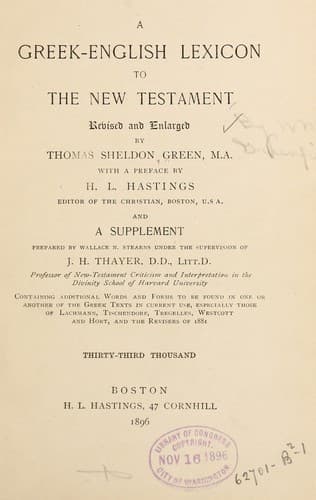
A Greek-English Lexicon to the New TestamentGreenfield, William
Religion
A Greek-English Lexicon to the New Testament
Greenfield, William
Bible. New Testament -- Dictionaries -- English; Greek language, Biblical -- Dictionaries -- English
Ἀπορφανίζω, (ἀπό & ὄρφανος)
f. ίσω,
to deprive, dereave, 1 Thes. 2.17.
Ἀποσκευάζομαι, (ἀπό & σκευάζω to pack up articles, σκεύη, for removal)
f. άσομαι,
to prepare for a journey, take one's departure, Ac. 21.15.
Ἀποσκίασμα, ατος, τό, (ἀπό & σκίαζο, to throw a shadow, fr. σκιά)
a shadow cast; met. the slightest trace, Ja. 1.17. L.G.
Ἀποσπάω, ῶ, (ἀπό & σπάω)
f. άσω,
to draw away from, to draw out or forth, Mat. 26.51; to draw away,
seduce, Ac. 20.30. mid. a.1. ἀπεσπάσθην, to separate one's self,
to retire, part, Lu. 22.41. Ac. 21.1. (ᾰ)
Ἀποστασία, ας, ἡ (ἀφίστημι)
a defection, apostasy; Ac. 21.21. 2 Thes. 2.3. L.G.
Ἀποστάσιον, ίου, τό, (fr. same)
defection, desertion, as of a freedman from a patron; in N.T.,
the act of putting away a wife, repudiation, divorce, Mat. 19.7.
Mar. 10.4, meton. a bill of repudiation, deed of divorce,
Mat. 5.31.
Ἀποστεγάζω, (ἀπό & στέγη)
f. άσω,
to remove or break through a covering or roof of a place,
Mar. 2.4.
Ἀποστέλλω, (ἀπό & στέλλω)
f. στελλῶ, a.1. ἀπέστειλα, p. ἀπέσταλκα, p. pass. ἀπέσταλμαι,
a.2. pass. ἀπεστάλην,
to send forth a messenger, agent, message, or command; to issue,
publish; put forth into action, Mar. 4.29; to despatch; to liberate,
dismiss, send away.
Ἀποστερέω, ῶ, (ἀπό & στερέω, to deprive)
f. ήσω, p. pass. ἀπεστέρημαι,
to deprive, detach; to debar, 1 Co. 7.5; to deprive in a bod sense,
defraud, Mar. 10.19. 1 Co. 6.7. mid. to suffer one's self to be
deprived or defrauded, 1 Co. 6.8; pass. to be destitute or devoid
of, 1 Ti. 6.5; to be unjustly withheld, Ja. 5.4.
Ἀποστολή, ῆς, ἡ, (ἀποστέλλω)
a sending, expedition; office or duty of one sent as a messenger
or agent; office of an apostle, apostleship, Ac. 1.25. Ro. 1.5.
1 Co. 9.2. Gal. 2.8.
Ἀπόστολος, ου, ὁ, (fr. same)
one sent as a messenger or agent, the bearer of a commission,
messenger; an apostle.
Ἀποστοματίζω, (ἀπό & στόμα)
f. ίσω,
pr. to speak or repeat off hand; also, to require or lead others
to speak without premeditation, as by questions calculated to
elicit unpremeditated answer, to endeavour to entrap into unguarded
language, Lu. 11.53.
Ἀποστρέφω, (ἀπό & στρέφω)
f. ψω,
to turn away; to remove, Ac. 3.26. Ro. 11.26. 2 Ti. 4.4; to turn a
people from their allegiance to their sovereign, pervert, incite
to revolt, Lu. 23.14; to replace, restore, Mat. 26.52; 27.3;
mid. a.2. ἀπεστράφην, 21to turn away from any one, to slight,
reject, repulse, Mat. 5.42. Tit. 1.14. Heb. 12.25; to desert,
2 Ti. 1.15.
Ἀποστῠγέω, ῶ, (ἀπό & στυγέω, to hate)
f. ήσω,
to shrink from with abhorrence, detest, Ro. 12.9.
Ἀποσυνάγωγος, ου, ὁ, ἡ, (ἀπό & συναγωγή)
expelled or excluded from the synagogue, excommunicated, cut off
from the rights and privileges of a Jew, and excluded from society,
Jno. 9.22; 12.42; 16.2. N.T.
Ἀποτάσσομαι, (ἀποτάσσω, to set apart, fr. ἀπό & τάσσω)
f. ξομαι,
to take leave of, bid farewell to, Lu. 9.61. Ac. 18.18, 21.
Public-domain text, read in full here on John Shaqi.
Reviews
Reviews
No reviews yet
Be the first to share your thoughts on this work.
Join the Discussion
Join the discussion
Sign in to leave a comment or review.
Sign InorCreate an account