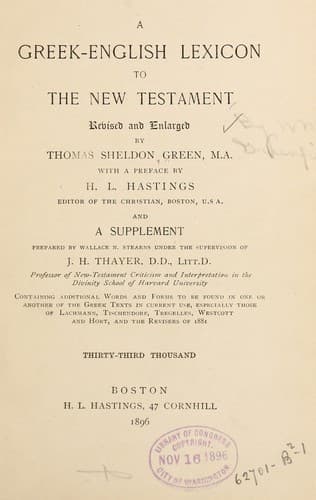
A Greek-English Lexicon to the New TestamentGreenfield, William
Religion
A Greek-English Lexicon to the New Testament
Greenfield, William
Bible. New Testament -- Dictionaries -- English; Greek language, Biblical -- Dictionaries -- English
5.37;
intrans., p. ἀφέστηκα, a.2. ἀπέστην, and
mid. to depart, go away from, Lu. 2.27. et al.;
met. to desist or refrain from, let alone,
Ac. 5.38; 22.29. 2 Co. 12.8; to make defection,
fall away, apostatise, Lu. 8.13. 1 Ti. 4.1. He. 3.12;
to withdraw from, have no intercourse with, 1 Ti. 6.5;
to abstain from, 2 Ti. 2.19.
Ἄφων,
adv. suddenly, unexpectedly, Ac. 2.2; 16.26; 28.6.
Ἀφόβως, (ἄφοβος, fearless, fr. ἀ & φόβος)
fearlessly, boldly, in trepidly, Phi. 1.14; securely,
peacefully, tranquilly, Lu. 1.74. 1 Co. 16.10; impudently,
shamefully, Jude 12.
Ἀφομαιόω, ῶ, (ἀπό & ὁμοιόω)
f. ώσω,
to assimilate, cause to resemble, He. 7.3.
Ἀφοράω, ῶ, (ἀπό & ὁράω)
f. ἀπόψομαι, a.2. ἀπεῖδον,
to view with undivided attention by looking away from
every other object; to regard fixedly and earnestly,
He. 12.2; to see distinctly, Phi. 2.23.
Ἀφορίζω, (ἀπό & ὁρίζω)
f. ίσω, & ἀφοριῶ, p. pass. ἀφώρισμαι,
to limit off; to separate, sever from the rest,
Mat. 13.49, et al.; to separate from society, cut off
from all intercourse, excommunicate, Lu. 6.22;
to set apart, select, Ac. 13.2. Ro. 1.1. Gal. 1.15.
Ἀφορμή, ῆς, ἡ, (ἀπό & ὁρμή)
pr. a starting point; means to accomplish an object;
occasion, opportunity, Ro. 7.8, 11, et al.
Ἀφρίζω,
f. ίσω,
to froth, foam, Mar. 9.18, 20:
from
Ἀφρός, οῦ, ὁ,
froth, foam, Lu. 9.39.
Ἀφροσύνη, ης, ἡ,
inconsiderateness, folly; folly, in the sense of
ostentation, boasting, 2 Co. 11.1, 17, 21; foolishness,
levity, wickedness, impiety, Mar. 7.22:
from
Ἄφρων, ονος, ὁ, ἡ, (ἀ & φρήν)
unwise, inconsiderate, simple, foolish, Lu. 11.40;
12.20.. 1 Co. 15.36; ignorant, destitute of the knowledge
of the true religion, Ro. 2.20. Ep. 5.17. 1 Pe. 2.15; vain,
ostentatious, 2 Co. 11.16, 19; 12.6, 11.
Ἀφυπνόω, ῶ, (ἀπό & ὕπνος)
f. ώσω,
to awake from sleep; in N.T., to go off into sleep,
fall asleep, Lu. 8.23.
Ἄφωνος, ου, ὁ, ἡ, (ἀ & φωνή)
dumb, destitute of the power of speech, 1 Co. 12.2.
2 Pe. 2.16; silent, mute, uttering no voice, Ac. 8.32;
inarticulate, consisting of inarticulate sounds,
unmeaning 1 Co. 14.10.
Ἀχάριστος, ου, ὁ, ἡ, (ἀ & χάρις)
unthankful, ungrateful, Lu. 6.35. 2 Ti. 3.2.
Ἀχειροποίητος, ου, ὁ, ἡ, (ἀ & χειροποίητος)
not made with hands, Mar. 14.58. 2 Co. 5.1.
Col. 2.11. N.T.
Ἀχλύς, ύος, ἡ,
a mist; darkening of the sight, Ac. 13.11.
Ἀχρεῖος, α, ον, (ἀ & χρεία)
useless, unprofitable, worthless, Mat. 25.30;
unmeritorious, Lu. 17.10:
whence
Ἀχρειόω, ῶ,
f. ώσω, a.1. pass. ἠχρειώθην,
to render useless; met. pass. to become corrupt,
depraved, Ro. 3.12. L.G.
Ἄχρηστος, ου, ὁ, ἡ, (ἀ & χρηστός)
unuseful, useless, unprofitable, and by impl.
detrimental, causing loss, Phile. 11.
Ἄχρι, v. ἄχρις,
originally an adv. of place; used as a prep., with
respect to place, as far as; to time, until, during;
as a conj., until.
Ἄχῠρον, ου, τό,
chaff, straw broken up by treading out the grain,
Mat. 3.12. Lu. 3.17.
Public-domain text, read in full here on John Shaqi.
Reviews
Reviews
No reviews yet
Be the first to share your thoughts on this work.
Join the Discussion
Join the discussion
Sign in to leave a comment or review.
Sign InorCreate an account