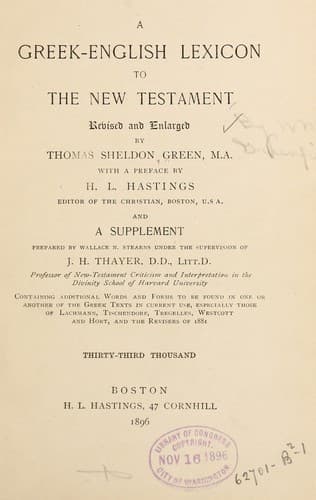
A Greek-English Lexicon to the New TestamentGreenfield, William
Religion
A Greek-English Lexicon to the New Testament
Greenfield, William
Bible. New Testament -- Dictionaries -- English; Greek language, Biblical -- Dictionaries -- English
to remove out of sight, cause to disappear; pass.
to disappear, vanish, Ja. 4.14; by impl. to destroy,
consume, so that nothing shall be left visible,
Mat. 6.19, 20; met. to spoil, deform, disfigure,
Mat. 6.16:
whence
Ἀφανισμός, οῦ, ὁ,
a disappearing, vanishing away; met. destruction,
abolition, abrogation, He. 8.13. L.G.
Ἄφαντος, ου, ὁ, ἡ, (ἀ & φαίνω)
not appearing, not seen, invisible;
hence, ἄφαντος γενέσθαι, to disappear, vanish,
Lu. 24.31.
Ἀφεδρών, ῶνος, ὁ, (ἀπό & ἕδρα, a seat)
a privy, Mat. 15.17. Mar. 7.19. L.G.
Ἀφειδία, ας, ἡ, (ἀ & φείδομαι)
pr. the disposition of one who is ἀφειδής, unsparing;
hence, in N.T., unsparingness in the sense of rigour,
severity, austerity, Col. 2.23.
Ἀφελότης, τητος, ἡ, (ἀφελής, not rough, plain,
met. simple, sincere, fr. ἀ & φελλεύς, a rough,
stony region)
sincerity, simplicity, Ac. 2.46. N.T.
Ἄφεσις, εως, ἡ, (ἀφίημι)
dismission, deliverance from captivity, Lu. 4.18, bis;
remission, forgiveness, pardon, Mat. 26.28, et al.
Ἁφή, ῆς, ἡ, (ἅπτω)
a fastening; a ligature, by which the different
members are connected, commissure, joint, Ep. 4.16.
Col. 2.19.
Ἀφθαρσία, ας, ἡ, (ἀ & φθείρω)
incorruptibility, incorruptness;
by impl. immortality, 1 Co 15.42, 53, 54.
with the accessory idea of felicity, Ro. 2.7, et al.;
ἐν ἀφθαρσίᾳ, purely, sincerely, constantly, Ep. 6.24. L.G.
Ἄφθαρτος, ου, ὁ, ἡ, (fr. same)
incorruptible, immortal, imperishable, undying,
enduring, Ro. 1.23. 1 Co. 9.25; 15.52, et al.
Ἀφθορία, ας, ἡ, (fr. same)
v.r. Tit. 2.7, pr. incapability of decay;
met. incorruptness, integrity, genuineness,
purity. N.T.
Ἀφίημι, (ἀπό & ἵημι)
f. ἀφήσω, a.1. ἀφῆκα, a.1. pass. ἀφειθην & ἀφέθην,
f. pass. ἀφεθήσομαι, imperf. 3 per. s. ἤφει,
Mar. 1.34; 11.16, p. pass. 3 per. pl. ἀφέωνται,
pres. 2 pers. s. ἀφεῖς, v.r. Re. 2.20.
to send away, dismiss, suffer to depart; to emit,
send forth; τὴν φωνήω, the voice, to cry out, utter an
exclamation, Mar. 15.37; τὸ πνεῦμα, the spirit,
to expire, Mat. 27.50; to omit, pass over or by,
neglect, care not, Mat. 15.14; 23.23. He. 6.1;
to permit suffer, let, forbid not; to give up, yield,
resign, Mat. 5.40; to remit, forgive, pardon; to relax,
suffer to become less intense, Re. 2.4; to leave,
depart from; to desert, forsake; to leave, remaining or
alone; to leave behind, sc. at one's death,
Mar. 12.19, 20, 21, 22. Jno. 14.27.
Ἀφικνέομαι, οῦμαι, (ἀπό & ἱκνέομαι, to come, arrive)
f. ίξομαι, a.2 ἀφικόμην,
to come, arrive at; to reach as a report, Ro. 16.19.
Ἀφιλάγαθος, οῦ, ὁ, ἡ, (ἀ & φίλος & ἀγαθός)
not a lover of, inimical to, good and good men,
2 Ti. 3.3. N.T.
Ἀφιλάργῠρος, ου, ὁ, ἡ, (ἀ & φίλος & ἄργυρος)
not fond of money, not covetous, liberal, generous,
1 Ti. 3.3. He. 13.5. N.T.
Ἄφιξις, εως, ἡ, (ἀφικνέομαι)
arrival; departure, Ac. 20.29.
Ἀφίστημι, (ἀπό & ἵστημι)
f. ἀποστήσω, a.1. ἀπέστηασ,
trans. to put away, separate; to draw off or away,
withdraw, induce to revolt, Ac.
Public-domain text, read in full here on John Shaqi.
Reviews
Reviews
No reviews yet
Be the first to share your thoughts on this work.
Join the Discussion
Join the discussion
Sign in to leave a comment or review.
Sign InorCreate an account