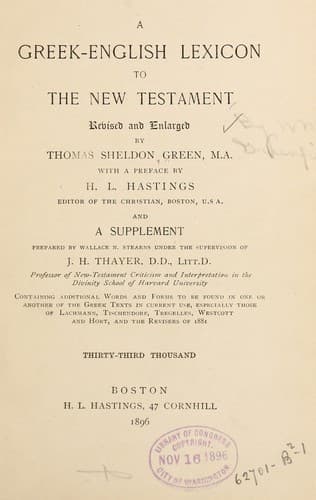
A Greek-English Lexicon to the New TestamentGreenfield, William
Religion
A Greek-English Lexicon to the New Testament
Greenfield, William
Bible. New Testament -- Dictionaries -- English; Greek language, Biblical -- Dictionaries -- English
There is another consideration; the Greek of the New Testament differs
materially in its character from the classical Green, or from the Greek
language as a whole. About b.c. 288, the law of Moses was translated
from Hebrew into Greek, by request of Ptolemy Philadelphus, who sought
everywhere for books to enrich his great library at Alexandria.
Subsequently other portions were translated, and hence, we have what is
known as the Septuagint version of the Old Testament. This was largely
used among the Jewish people in Egypt and elsewhere in the time of our
Saviour. It was a Greek version of a Hebrew book, and it was through
this book, as well as by intercourse with Grecian people and foreigners
of the Jewish stock, that the Jewish people became acquainted with the
Greek tongue. But the Greek of the Septuagint was full of Hebrew ideas
and idioms, and hence the Greek of the Jews in Palestine, and of the New
Testament which is also saturated with Old Testament ideas, differed
from the ordinary language of the Greeks, new meanings having been
imparted to various words, in order that they might represent Hebrew
words and Hebrew ideas. For example, when the Greek word hades is used,
we are not thereby committed to a belief in all the fabulous ideas of
the Greeks concerning the abode of the dead, for the word was but the
representative of the Hebrew word sheol, which is almost always
translated hades in the Greek Testament. Hence in studying this Greek
word in the New Testament we are not to go to the Greek classics to find
out what they mean by the word hades, but rather to the Hebrew prophets
to learn in what sense they use the Hebrew word sheol, of which it is
the Greek equivalent. So the word diatheke in classic Greek signifies a
will, testament, covenant, and so the term in the common English version
is translated in both these ways. But in the Septuagint the word
diatheke is used to translate the Hebrew word berith, which signifies a
covenant, but does not signify a will or testament.1* Hence, instead of
speaking of "The New Testament" we should more correctly call it the
"The New Covenant." A variety of instances might be adduced where New
Testament Greek words have meaning widely different from the same words
in classic Greek.
Public-domain text, read in full here on John Shaqi.
Reviews
Reviews
No reviews yet
Be the first to share your thoughts on this work.
Join the Discussion
Join the discussion
Sign in to leave a comment or review.
Sign InorCreate an account