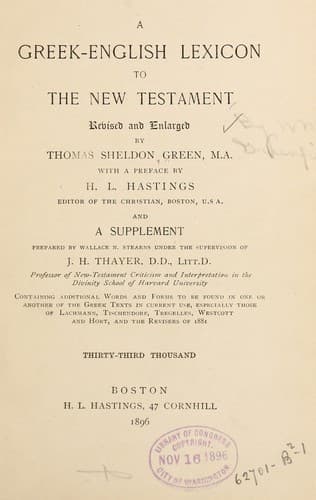
A Greek-English Lexicon to the New TestamentGreenfield, William
Religion
A Greek-English Lexicon to the New Testament
Greenfield, William
Bible. New Testament -- Dictionaries -- English; Greek language, Biblical -- Dictionaries -- English
It must also be remembered, that there are words in the New Testament
which are not found at all in the classical writers. When new ideas are
to be conveyed, new words must be found to convey them. In the language
of the Hindus there is no word for home, simply because the Hindu has no
home. The idea of a home as understood by Christians, is utterly foreign
to the Hindu nation and religion. There are heathen nations that have no
word for gratitude, because gratitude is unknown to them; so the word
agape or charity, which describes unselfish love, a love which reaches
to enemies, and which seeks no personal gratification or reward,—that
love which is of God, and concerning which it is said, "God is Love,"
refers to something unknown to the heathen world. They had no word to
express it, because they had not the thing itself to express.
These illustrations indicate some of the peculiarities of the New
Testament Greek, and serve to show use why the student of the Bible
needs an especial apparatus for studying the Greek New Testament. For
this purpose, he has been most generously furnished with New Testament
lexicons, in different languages, Latin, German, and English, by the
labor of devout and learned students. Among the most noteworthy may be
mentioned Robinson's Greek Lexicon of the New Testament, and Prof. J. H.
Thayer's later and more elaborate Greek-English Lexicon of the New
Testament, based upon Prof. Grimm's get Lexicon; which is well adapted
to meet the needs of the critical student.
The meaning of words is determined finally by their usage by those who
employ them, and the only way to settle the sense of disputed and
difficult words is carefully to examine each word in its connection, in
all the passages where it is used, and in the light of that examination
decide as to its meaning or meanings. In some of the more elaborate
lexicons a large number of passages are thus cited, illustrating the use
of the words under consideration, and it some cases authors have
endeavored to give nearly every passage where a word occurs in the New
Testament. This however, cumbers the lexicon with a large amount of
material which in most instances is of little use. This examination and
comparison of passages, the careful student should make for himself, and
his interests in this direction are better served by the use of a
concordance; and for those who wish to investigate carefully the meaning
of Greek words in the New Testament, ample provision has been made in
the Critical Greek and English Concordance, prepared by Prof. C. F.
Hudson, under the direction of H. L. Hastings, and revised and completed
by the late Ezra Abbot, D.D., LL.D., Profession of New Testament
Criticism and Interpretation in the Divinity School of Harvard
University.
Public-domain text, read in full here on John Shaqi.
Reviews
Reviews
No reviews yet
Be the first to share your thoughts on this work.
Join the Discussion
Join the discussion
Sign in to leave a comment or review.
Sign InorCreate an account