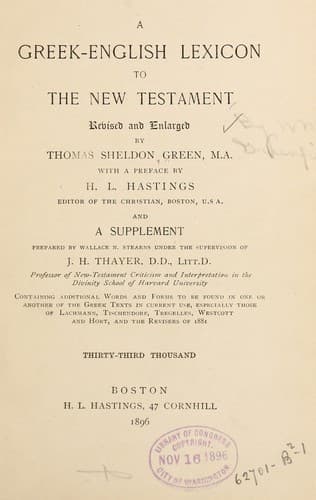
A Greek-English Lexicon to the New TestamentGreenfield, William
Religion
A Greek-English Lexicon to the New Testament
Greenfield, William
Bible. New Testament -- Dictionaries -- English; Greek language, Biblical -- Dictionaries -- English
meton. by metonymy
metath. metathesis, the transportation of letter.
mid. middle voice.
N.T. New Testament
opt. optative mood.
O.T. Old Testament
part. participle.
pass. passive voice.
r. per. perfect tense.
plu. p. pluperfect tense.
pl. plural.
pr. properly.
preced. preceding.
prep. preposition.
pron. pronoun.
quater four times.
sc. scilicet, that is to say, that is.
seq. sequente, as, seq. gen. sequente genitivo, with
a genitive following.
sing. signular–the figure, placed before sign. or
pl. denote the person.
spe. specially, i.e. in a special and local meaning.
subj. subjunctive mood.
subs. substantive.
superl. superlative.
ter. thrice.
trans. transitively.
trop. tropically, i.e. turned aside from its strick
literal meaning.
v. vel, or.
v.r. a various reading to the commond text.
vix. videlicet, that is, namely
voc. vocative case
ὀ attached to a word show it to be masculine;
ἡ, to be feminine;
ὁ ἡ to be common, i.e. masculine or feminine; and
τό, to be neuter.
GREEK AND ENGLISH LEXICON
To The
NEW TESTAMENT
Α, α, Ἄλφα
Α, α, Alpha,
the first letter in the Greek Alphabet, and used for the first,
Re. 1.8, 11; 21.6; 22.13.
In composition, it denotes privation; sometimes augmentation,
and union.
Αβᾰρής, έος, οῦς, ὁ, ἡ, τὸ, -ές, (ἀ & βάρος)
not burdensome, not chargeable, 2 Co. 11.9.
Αββᾶ
ind. ch. or Sy. אבא, father, Mar. 14.36. Ro.8.15 Ga. 4.6.
Ἄβυσσος, ου, ἡ,
pr. bottomless; place of the dead, hell.
Ἀγαθοεργέω, ῶ, Ἀγαθουργῶ, (ἀγαθός & ἔργον)
f. ήσω,
to do good, confer benefits, 1 Ti.6.18 N.T.
Αγαθοποιέω, ῶ, (ἀγαθός & ποιέω)
f. ήσω,
to do good, benefit, do well: (S.)
whence
Ἀγαθοποιΐα, ας, ἡ,
well-doing, probity, 1 Pe. 4.19 L.G.
Ἀγαθοποιός, οῦ, ὁ, ἡ,
a well-doer, 1 Pe. 2.14 L.G.
Ἀγᾰθός, ή, όν,
good, profitable, generous, beneficent, upright, virtuous:
whence
Ἁγαθωσύνη, ης, ἡ,
goodness, virtue, beneficence. S.
Αγαλλίᾱσις, εως, ἡ,
exultation, extreme joy: (S.)
from
Ἀγαλλιάω, ῶ,
f. άσω,
to celebrate, praise; also equivalent to Αγαλλιάομαι, ῶμαι,
to exult, rejoice exceedingly; to desire ardently, Jno. 8.56. S.
Ἀγᾰμος, ου, ὁ, ἡ (ἀ & γάμος)
unmarried. 1 Co. 7.8, 11, 32, 34.
Ἀγανακτέω, ῶ,
f. ήσω,
to be pained; to be angry, vexed, indignant; to manifest
indignation:
whence
Ἀγανάκτησις, εως, ἡ,
indignation, 2 Co. 7.11.
Ἀγαπάω, ῶ,
f. ήσω, p. ἠγάπηκα,
to love, value, esteem, feel or manifest generous concern for,
be faithful towards; to delight in; to set store upon, Re. 12.11:
whence
Ἀγάπη, ης, ἡ,
to love, generosity, kindly concern, devotedness; pl.
love-feasts, Ju. 12. S.
Ἀγαπητός, ή, όν,
beloved, dear; worthy of love.
Ἀγγαρεύω, (ἄγγαρος, a Persian courier, or messenger, who had authority
to press into his service men, horses, &c.)
f. εύσω,
to press or compel another to go somewhere, or carry some burden.
Ἀγγεῖον, ου, τό,(ἄγγος, the same)
Public-domain text, read in full here on John Shaqi.
Reviews
Reviews
No reviews yet
Be the first to share your thoughts on this work.
Join the Discussion
Join the discussion
Sign in to leave a comment or review.
Sign InorCreate an account