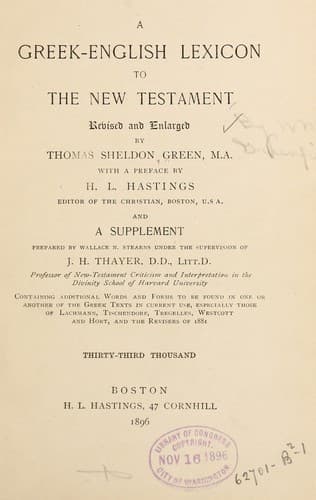
A Greek-English Lexicon to the New Testament — John Shaqi
A Greek-English Lexicon to the New TestamentGreenfield, William
Religion
A Greek-English Lexicon to the New Testament
Greenfield, William
Bible. New Testament -- Dictionaries -- English; Greek language, Biblical -- Dictionaries -- English
With a desire to give completeness to this Lexicon, a list of these
words is presented, with definitions and a record of the places where
they occur, at the end of the Lexicon. This list has been prepared by
Mr. Wallace N. Stearns, under the supervision of Prof. J. Henry Thayer,
of Harvard Divinity School, the successor of the lamented Dr. Ezra
Abbot, and one of the revisers of the New Testament, whose arduous
labors in the department of sacred lexicography are too well-known to
need further mention.
With these statements as to the object and character of this Lexicon, we
commit this new edition to the kind of providence of Him whose words of
truth are therein expounded, and without whose blessings all labor and
effort is but in vain.
H.L. Hastings
Scriptural Tract Repository,
Boston, Mass., June, 1896.
EXPLANATIONS
Allusion has been made in the preface to certain peculiarities of New
Testament Greek, which distinguish it from the classic Greek of the
heathen world.
This Lexicon indicates some of these peculiarities, by distinguishing
three classes of words:
I. Later Greek words, marked L. G., the occurrence of which may be
regarded as commencing within the Later Greek period, which is here
reckoned from and includes the writing of the historian Polybius, B.C.
204-123.
II. New Testament words, marked N. T., which only occur in the New
Testament, or if found elsewhere are only in certain peculiar quarters.
III. Septuagint words, marked S., which besides their occurrence in the
New Testament are found only in the Septuagint Version of the Old
Testament, the Greek Apocryphal books, and kindred writings; and the
meaning of which is to be studied, not in the usage of classical Greek
writings, but rather in the light of the Hebrew Old Testament, and the
writings of Jewish authors who were familiar with Hebrew ideas and
Hebrew literature.
ABBREVIATIONS, ETC.
Used In The Following Lexicon
a. Aorist.
absol absolutely, without case or adjunct.
accus accusative case
adj. adjective.
adv. adverb.
al. alibi, in other texts.
al. freq. alibi frequenter. in many other texts
Aram Aramaena.
At. Attic dialect
bis. twice.
cf. confer, compare.
coll. collato, being compared.
comp. comparative.
conj. conjunction.
contr. contraction, or contracted.
dat. dative case.
dimin. diminutive.
enclit. enclitic, throwing the accent on the preceding syllable.
& et. and.
e.g. exempli gratia, for example.
f. future tense.
fr. from.
gen. genitive case.
genr. generally, in a general sense, not affected by adjuncts.
Heb. Hebrew, or the Hebrew idiom.
i.e. id est, that is.
idem. the same.
imperat. imperative mood
imperf. imperfect tense.
impers. impersonal.
impl. implication.
i.q. same as.
inf. infinitive mood.
int. interj. interjection.
intrans. intransitive.
lit. litterally
met. metaphorically
Public-domain text, read in full here on John Shaqi.
Reviews
Reviews
No reviews yet
Be the first to share your thoughts on this work.
Join the Discussion
Join the discussion
Sign in to leave a comment or review.
Sign InorCreate an account