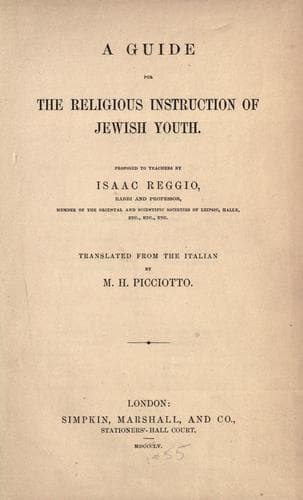
A Guide for the Religious Instruction of Jewish YouthReggio, Isaac Samuel
Religion
A Guide for the Religious Instruction of Jewish Youth
Reggio, Isaac Samuel
Judaism -- Juvenile literature
IV. Again, whoever attentively contemplates the universe cannot help
discovering, with admiration, in every part of it a stupendous art, a
constant order, a systematic correspondence of means to ends, which
demonstrate that all has been arranged on a predetermined plan and for a
fixed purpose, to which all the particular dispositions developed in the
course of the natural phenomena are exquisitely adapted. This order and
this harmony--which manifest themselves, also, in all the progressive
courses of nature--indicate a self-developing excellence, and a tendency
to an ever-increasing perfectibility, such as can only emanate from a
cause infinitely intelligent and good; and as such qualities cannot be
attributed to a being corporeal, because limited and subject to changes,
it follows that the Author of the universe is all-wise and good, pure
and immutable.
V. Now, this Being, necessary and eternal, whom the contemplation of the
universe alone reveals to us as the Author of everything, as omnipotent,
free, all-provident, omniscient, infallible, pure, immutable, all-wise,
and good, is He whom we call GOD.
VI. But our conviction of the existence of God need not be derived
exclusively from the wonders of the universe; for every man can find in
himself the evident proof of the existence of that supreme cause. In
fact, man feels within himself that he thinks; and if he were even to
doubt it, he could not deny that at least he doubts; and the doubt
itself is already a thought. Admitting that he possesses the faculty of
thinking, he must admit that there is within himself a substance, a
being, a something which thinks. But this being, who is conscious of his
own thoughts, is also conscious that he exists not by himself, that he
has not existed from all eternity, that he is subject to changes, that
even the simple ideas, which compose his thoughts, are not produced by
himself, but acquired through his senses from external objects; and, in
short, that he depends upon various causes placed without himself, and
undergoes vicissitudes, which it is not in his power to remove.
Therefore man has not within himself the reason of his own existence,
but he must trace it to another, who is the Author of it. Now, this
Author cannot have received His own existence from another, if He is to
be considered the primary cause; otherwise we should fall into a
succession of causes and effects to infinity. Then, the true Author of
our existence is one who exists by Himself, and as such He is eternal,
omnipotent, all-wise, etc., etc.; He is God.
Public-domain text, read in full here on John Shaqi.
Reviews
Reviews
No reviews yet
Be the first to share your thoughts on this work.
Join the Discussion
Join the discussion
Sign in to leave a comment or review.
Sign InorCreate an account