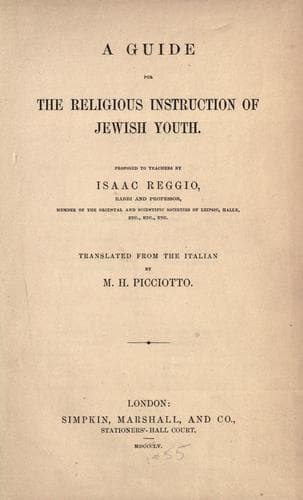
A Guide for the Religious Instruction of Jewish YouthReggio, Isaac Samuel
Religion
A Guide for the Religious Instruction of Jewish Youth
Reggio, Isaac Samuel
Judaism -- Juvenile literature
VII. Another source, affording the proof of the existence of God, man
finds in himself when his intellectual faculties have attained a certain
degree of culture and maturity. He then knows himself to be a moral
being; that is to say, a being who, placed between good and evil, can,
of his own free will, adhere to the former and reject the latter, if he
follows the dictates of his reason. Then the moral sense awakens in his
mind the idea of a supreme blessing, of a progressive and infallible
moral perfection, of a future final accord between virtue and felicity,
and their necessary co-existence. Now, he cannot expect this supreme
blessing from anything that surrounds him in nature, because he does not
find in the latter the desired union of happiness with virtue, enjoyment
with merit. He must, therefore, seek it in a Supreme Cause existing out
of nature--in a Cause which should contain in itself the type of the
moral law, embrace the whole extent of that law with infinite
intelligence, and act up to its dictates with a powerful will. This
Supreme Cause is God.
CHAPTER II.
VIII. MAN has many advantages and privileges over all other creatures.
Not only can he, like other animals, perceive through his senses all the
surrounding objects, but he can compare with one another the perceptions
received, associate them together, separate them, and form new ideas. He
can know for what purposes things exist, investigate their causes and
effects, discern between good and evil, between just and unjust; he
alone can communicate his thoughts to others; he alone can speak.
IX. Everything produced by an intelligent Author must be intended for
some purpose--must have a _destination_. Man, the noblest creature on
earth, must also have a destination. We shall arrive at a clear
knowledge of that destination, when we shall have considered the powers
and capabilities possessed by him; for the means with which nature has
endowed him, for the development of his activity, evidently point out
the goal which that activity is designed to attain.
X. Now, the capabilities that we discover in man are the
following:--Besides a body constructed with wonderful skill, but weak,
corruptible, mortal, man has within himself a vivifying principle, which
substantiates in him the knowledge of things with the aid of the senses,
renews in him perceptions once received, unites them, separates them,
and forms out of them new ideas. This thinking principle is certainly
different from the body, of which no part is apt to think, and is what
we call the _soul_; the act itself of thinking proceeds from a faculty
of the soul which we call _intellect_.
Public-domain text, read in full here on John Shaqi.
Reviews
Reviews
No reviews yet
Be the first to share your thoughts on this work.
Join the Discussion
Join the discussion
Sign in to leave a comment or review.
Sign InorCreate an account