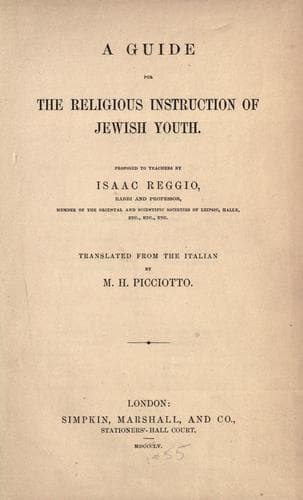
A Guide for the Religious Instruction of Jewish YouthReggio, Isaac Samuel
Religion
A Guide for the Religious Instruction of Jewish Youth
Reggio, Isaac Samuel
Judaism -- Juvenile literature
XVI. Now, by freely and spontaneously resolving to conform all the
actions of his life to the dictates of reason, which commands him to be
wise in his self-government, upright with others, and pious towards the
supreme Author, man will have worthily corresponded to the end for which
he was created--he will have fulfilled his _destination_; for it is
clearly the destination of man to make the best possible use of the
sublime faculties with which his soul is endowed; and the best possible
use he does make when he subordinates his inferior to his superior
tendencies, the cravings of the body to those of the soul; in a word,
when he obeys the dictates of reason.
XVII. When man obeys the dictates of reason, an internal voice in his
heart tells him that he has done right; he feels satisfied with himself,
and is penetrated with a sense of true joy. When, on the contrary, he
consciously infringes the laws of reason, he is not only deprived of
that internal approbation, but an inextinguishable voice rises
reproachful within his heart; he is no longer satisfied with himself,
but feels uneasiness and perturbation. That internal voice, which judges
man's actions, and generates happiness or sorrow, is what is called
_Conscience_.
XVIII. But the human soul, when it concentrates itself within, has also
the faculty of feeling the sense of its own individuality, and
perceiving that the state in which it is is its own. By virtue of this
sense, which we may call feeling, the soul is led always to desire its
own welfare, its own happiness; thence springs love or hatred,
inclination or aversion towards an object, as this object seems apt to
occasion pleasure or pain. But man, sooner or later, discovers that a
true and permanent pleasure cannot be obtained through any of the
physical enjoyments on earth, which he may not always be able to
procure, or, when procured, leave after them weariness and disgust. He,
consequently, cannot place in them his true happiness; and his internal
sense tells him that there are other enjoyments of a purely spiritual
nature, which alone can satisfy the highest aspirations of his soul. The
exercise of his moral duties--which, through his freedom of action, lies
always within his power, and by which alone he can tranquillise his
conscience and fully delight in self-contentment--is that which offers
to his soul true and permanent enjoyment; that alone is worth desiring.
CHAPTER III.
Public-domain text, read in full here on John Shaqi.
Reviews
Reviews
No reviews yet
Be the first to share your thoughts on this work.
Join the Discussion
Join the discussion
Sign in to leave a comment or review.
Sign InorCreate an account