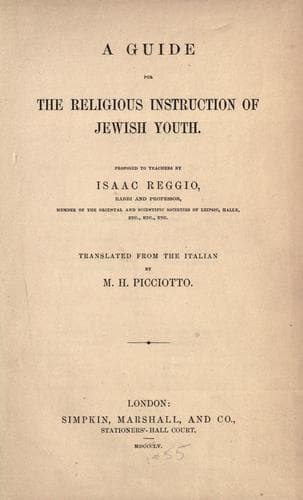
A Guide for the Religious Instruction of Jewish Youth — John Shaqi
A Guide for the Religious Instruction of Jewish YouthReggio, Isaac Samuel
Religion
A Guide for the Religious Instruction of Jewish Youth
Reggio, Isaac Samuel
Judaism -- Juvenile literature
XI. But the soul can also judge, conclude from causes to effects,
distinguish between good and evil, between just and unjust, conceive an
idea of things never perceived through the senses; it can recognise the
supreme Author of the universe, it can adore God. This faculty of the
soul is called _reason_; intellect and reason are the principal or
superior faculties of the human soul.
XII. Reason points out good as a thing desirable, and evil as a thing to
be avoided; yet man feels within himself a desire or impulse towards all
that is pleasurable to the senses, although reason may represent it to
him as an evil. And, on the other hand, he is conscious of his perfect
freedom of choosing good, however disagreeable to the senses, and of
abhorring evil, however tempting it may appear; he has, then, the
faculty of directing his action to one or other of these two courses;
his soul is endowed with _free-will_.
XIII. A being endowed with intellect, reason, and free-will cannot be
composed of parts, because the operations proceeding from such faculties
presuppose a comparison of various relations with each other, and a
deduction of consequences from their principles; and these operations
require such a unity and simplicity in their subject as are absolutely
incompatible with the nature of matter, composed, as it is, of parts.
The human soul is therefore a simple being, a _spirit_, and, as such,
indestructible, _immortal_.
XIV. Man, then, unites in himself two natures, belongs to two classes of
beings very different from one another, is a citizen of two worlds. In
his body he is linked to the material world, undergoes all the
vicissitudes of matter, is subject to the incentives of the senses, and
is impelled to gratify the wants and cravings of physical enjoyment. As
regards his soul, he enters into the sphere of intelligences, he feels
himself attracted by the ideas of the beautiful, of the true, of the
just; he participates in the condition of the spiritual beings, aspires
to the immense, to the infinite; and is susceptible of an
ever-increasing perfectibility, finding within himself the power of
abhorring moral evil, viz., vice, and of cleaving to moral good, viz.,
virtue.
XV. Man has, therefore, within himself a germ of discord between the two
principles of which he is constituted, a contrast between the exigencies
of the body and those of the soul--between the appetites of the senses
and the dictates of reason; and as this latter alone is competent to
form a judgment on what he ought or ought not to do, it follows that
reason alone should be consulted and obeyed in determining upon every
action.
Public-domain text, read in full here on John Shaqi.
Reviews
Reviews
No reviews yet
Be the first to share your thoughts on this work.
Join the Discussion
Join the discussion
Sign in to leave a comment or review.
Sign InorCreate an account