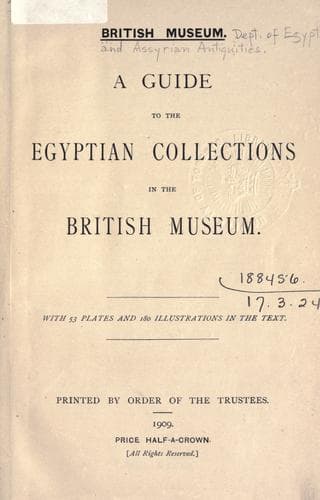
A guide to the Egyptian collections in the British MuseumBritish Museum. Department of Egyptian and Assyrian Antiquities
History
A guide to the Egyptian collections in the British Museum
British Museum. Department of Egyptian and Assyrian Antiquities
Egypt -- Antiquities
The Egyptian texts supply no details of the methods employed in
embalmment, but classical writers describe the processes at some length,
and the mummies which have been unrolled and examined prove that their
statements are on the whole correct. According to Herodotus (ii, 85)
there were =three methods of embalming= in use in his time. In the
=first= or most expensive =way=, the brains and viscerae were removed
from the body, which was carefully washed with palm wine, and then
sprinkled with powdered spices. The cavities in the head and body were
next filled with pounded myrrh, cassia, etc., and the opening in the
abdomen through which the viscerae were taken out was sewed up. A tank
containing a solution of salt, or soda, was prepared, and the body was
steeped in it for seventy days. At the end of this period it was taken
out of the solution, dried, and anointed with sweet-smelling unguents;
then the swathing with linen strips was begun. Sometimes, in the case
of women, the cheeks and lips were painted, the eye-lids smeared with
eye-paint, and other attempts made to give to the face the semblance of
life before swathing. The fingers and toes were each swathed separately,
then the legs and arms, and finally, when pads and wads of linen had
been fixed in various places to keep the swathings in position, and to
give to the mummy the traditional form of the mummy of Osiris, the body
and head were wrapped up in large sheets of linen, which were held in
place by stout bands. As each swathing was placed on the body, a priest
who was specially appointed said the formula which applied to it, and in
cases where a large number of amulets were used, these objects, which
were intended to give to the mummy the protection of the various gods,
were inserted, under his directions, in their proper places between the
swathings. When the swathing of the body was ended, the name of the
deceased was usually written in ink on one of the outer coverings.
Public-domain text, read in full here on John Shaqi.
Reviews
Reviews
No reviews yet
Be the first to share your thoughts on this work.
Elsewhere in the archive
Join the Discussion
Join the discussion
Sign in to leave a comment or review.
Sign InorCreate an account