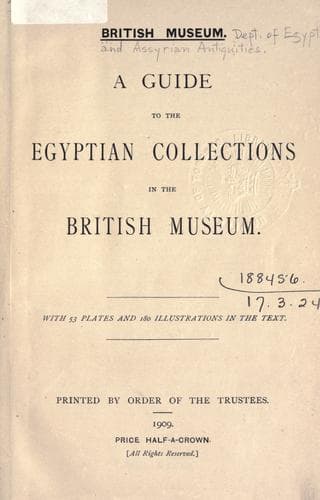
A guide to the Egyptian collections in the British MuseumBritish Museum. Department of Egyptian and Assyrian Antiquities
History
A guide to the Egyptian collections in the British Museum
British Museum. Department of Egyptian and Assyrian Antiquities
Egypt -- Antiquities
In the =second method= of embalming, the viscerae were removed by
means of oil of cedar, and the flesh was dissolved off the bones by
a preparation of soda; mummies which were prepared by this process
consist of nothing but skin and bone. The =third method= was used almost
exclusively for the poor; the body was steeped in a preparation of soda
for a period of seventy days, and then handed over to the relatives for
burial. The period which elapsed between death and burial varied in
length. From the inscriptions we learn that in one case the embalming
lasted 16 days, the swathing in linen 35 days, and the burial 70 days,
_i.e._, 121 days in all. In another, the embalming occupied 66 days, the
preparations for burial 4 days, and the burial 26 days, in all 96 days.
According to the Bible (Genesis l, 3), the embalming of Jacob occupied
40 days, but the period of mourning was 70 days. Certain stelae in the
British Museum[24] mention 70 days, and we may assume that this period
was commonly observed, at all events, in Graeco-Roman times.
=Cost of embalming.=—According to Diodorus, who lived about B.C. 40, the
methods of embalming were three in number; the first cost one talent of
silver, about £250; the second, twenty minae, about £60; and the third
very little indeed. In the description of the first method given both
by Herodotus and Diodorus, it is said that the intestines were removed
from the body previous to embalming, but neither writer says what was
done with them afterwards. We know, however, that they were cleansed,
and wrapped in linen with powdered spices, salt, etc., and placed in a
series of four jars, or vases, to which modern writers have given the
name =Canopic Jars=. They were thus named by the early Egyptologists, who
believed that in them they saw some confirmation of the legend handed
down by certain ancient writers to the effect that Canopus, the pilot
of Menelaus, who is said to have been buried at Canopus, in Egypt, was
worshipped there under the form of a jar with small feet, a thin neck, a
swollen body, and a round back. Each “Canopic” jar was dedicated to one
of the =four sons of Horus=, or sons of Osiris, who were also the gods of
the =four cardinal points=; and each jar was provided with a lid made in
the shape of the head of the deity to whom it was dedicated. The names of
the four gods were:—
1. =Mesthȧ= 𓅓𓋴𓍘𓇋𓀭, or ȦMSET 𓇋𓅓𓋴𓏏𓀭; he was man-headed.
2. =Ḥāpi= 𓐑𓊪𓇌𓀭; he was dog-headed.
3. =Ṭuamutef= 𓇼𓅐𓏏𓆑𓀭; he was jackal-headed.
4. =Qebḥsennuf= 𓈎𓃀𓎛𓏁𓈗𓌣𓌣𓌣𓆑𓀭; he was hawk-headed.
Public-domain text, read in full here on John Shaqi.
Reviews
Reviews
No reviews yet
Be the first to share your thoughts on this work.
Elsewhere in the archive
Join the Discussion
Join the discussion
Sign in to leave a comment or review.
Sign InorCreate an account