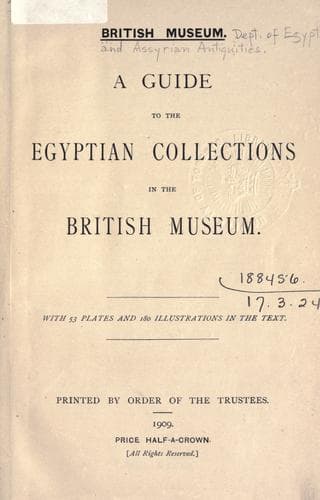
A guide to the Egyptian collections in the British MuseumBritish Museum. Department of Egyptian and Assyrian Antiquities
History
A guide to the Egyptian collections in the British Museum
British Museum. Department of Egyptian and Assyrian Antiquities
Egypt -- Antiquities
These gods represented the south, north, east, and west respectively, and
the goddesses with whom they were associated were Isis, Nephthys, Neith,
and Serqet. Mesthȧ protected the stomach and large intestines; Ḥāpi, the
small intestines; Ṭuamutef the lungs and heart; and Qebḥsennuf the liver
and gall bladder. The custom of mummifying the intestines separately
is as old as the VIth dynasty at least, and the gods of the cardinal
points who presided over them are mentioned several times in the texts of
Unȧs, Pepi, and other kings of the Vth and VIth dynasties. The four jars
were usually placed in a coffer, or chest, specially prepared for the
purpose; and this is frequently depicted in representations of funeral
processions. The Ani Papyrus shows the four sons of Horus standing by
the coffer containing the mummified intestines of the deceased, and his
renewed body rising through the cover of it, holding “life” 𓋹 in each
hand (see page 138). Among the fine collection of “Canopic” jars in the
British Museum may be specially mentioned the set made for Ḳua-ṭep, XIth
dynasty, No. 30,838 (Third Egyptian Room, Wall-case No. 112), and the
sets Nos. 22,374-7, and 9562-5, of the later period, in Wall-cases Nos.
74 and 75 (Second Egyptian Room).
The custom of mummifying the dead appears to have been unknown in the
Predynastic Period. In the earliest attempts made to preserve the
body, the plan followed was to remove the intestines, and then to dry
it in the sun, or to rub it with salt. The skulls found in the tombs
are usually empty, a fact which proves that the embalmers were able to
remove the brain and membranes without injury to the bridge of the
nose; sometimes they contain bitumen, or some kind of resin, which must
have been introduced into them by the way through which the brains were
extracted, _i.e._, through the nostrils. Mummies cured with unguents
and spices do not last long when unrolled; the skin of those cured with
natron, _i.e._, a mixture of carbonate, sulphate, and muriate of soda,
is hard, and comparatively durable, but it hangs loosely from the bones,
which are white and somewhat friable; bodies from which the intestines
have been removed, and which have been preserved by being filled with
bitumen, are quite black and hard, and practically speaking, last for
ever. The dead poor were sometimes merely salted and laid in a common pit
or cave. At one period the dead were embalmed in honey: the treatment
of the child who was found in a sealed jar of honey, mentioned by the
Muḥammadan writer ʿAbd al-Laṭîf, and the body of Alexander the Great
being well-known instances of the custom.
Public-domain text, read in full here on John Shaqi.
Reviews
Reviews
No reviews yet
Be the first to share your thoughts on this work.
Elsewhere in the archive
Join the Discussion
Join the discussion
Sign in to leave a comment or review.
Sign InorCreate an account