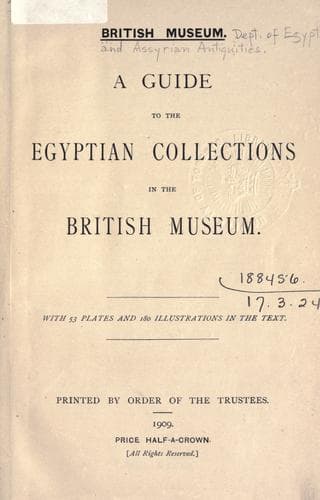
A guide to the Egyptian collections in the British MuseumBritish Museum. Department of Egyptian and Assyrian Antiquities
History
A guide to the Egyptian collections in the British Museum
British Museum. Department of Egyptian and Assyrian Antiquities
Egypt -- Antiquities
Under, or soon after the XXVIth dynasty, the Egyptians began to place
their mummified dead in brightly painted =cartonnage cases=, decorated
with inscriptions containing the pedigree of the deceased, religious
texts, figures of gods, etc., and to set them upright in the halls of
their houses. The faces were painted to resemble those of the dead, and
attempts were made to reproduce the natural colour of their skins, hair,
and eyes, and even to represent small physical peculiarities. A man’s
immediate ancestors formed a part of his household.
About the beginning of the Graeco-Roman Period, or in the first century
after Christ, it became the custom among the ruling class in Egypt to
insert =painted portraits= of the dead in the linen swathings over
their faces. Specimens of such portraits may be seen in Case Y in the
Second Egyptian Room, and in Wall-cases Nos. 70 and 71. A century or two
later further attempts were made to abolish from mummies the funerary
swathings, etc., and the dead were placed in =papyrus cases=, which were
moulded to their forms, and were painted with coloured representations of
their clothes and ornaments. Very fine examples of such painted papyrus
cases are exhibited in Wall-cases 64 and 65 in the First Egyptian Room,
and they are of special interest as showing what kinds of garments and
jewellery were worn by the Graeco-Egyptian ladies of Egypt, and how they
were decorated. In the case of men, painted portraits were inserted
over the faces, and the rest of the mummy was covered with plaster,
usually coloured pink or red, and ornamented with faulty imitations of
the scenes found on the old cartonnage cases. The best example of this
kind of mummy is that of Artemidorus, exhibited in Wall-case 63 in the
First Egyptian Room. The figures of the gods, etc., are painted in gold,
and the mistakes in them prove that the artist did not understand the
signification of the scenes which he was copying. The old theology of
Egypt was forgotten, the meanings of the old funerary texts and scenes
were lost, and the artist found himself obliged to use the form of
address to the dead customary among the Greeks, _i.e._, “O Artemidorus,
farewell!”
Public-domain text, read in full here on John Shaqi.
Reviews
Reviews
No reviews yet
Be the first to share your thoughts on this work.
Elsewhere in the archive
Join the Discussion
Join the discussion
Sign in to leave a comment or review.
Sign InorCreate an account