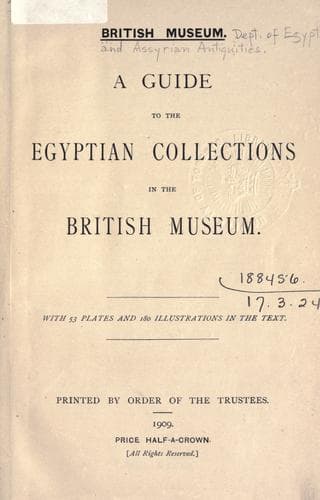
A guide to the Egyptian collections in the British Museum — John Shaqi
A guide to the Egyptian collections in the British MuseumBritish Museum. Department of Egyptian and Assyrian Antiquities
History
A guide to the Egyptian collections in the British Museum
British Museum. Department of Egyptian and Assyrian Antiquities
Egypt -- Antiquities
The most important characteristic of the Nile is its annual flooding or
=Inundation=. By the end of May, in Egypt, the river is at its lowest
level. During the month of June the Nile, between Cairo and Aswân, begins
to rise, and a quantity of “green water” appears at this time. The cause
of the colour is said to be myriads of minute algae, which subsequently
putrefy and disappear. During August the river rises rapidly, and its
waters assume a red, muddy colour, which is due to the presence of the
rich red earth which is brought into the Nile by the Blue Nile and the
Atbara. The rising of the waters continues until the middle of September,
when they remain stationary for about a fortnight or three weeks. In
October a further slight rise occurs, and then they begin to fall; the
fall continues gradually until, in the May following, they are at their
lowest level once more. The cause of the Inundation is, as Aristotle (who
lived in the fourth century B.C.) first showed, the spring and early
summer rains in the mountains of Ethiopia and the Southern Sûdân; these
are brought down in torrents by the great tributaries of the Nile, viz.,
the Gazelle River, the Sobat (the Astasobas of Strabo), the Giraffe
River, the Blue Nile, and the Atbara. The Sobat rises about April 15, the
Gazelle River and the Giraffe River about the 15th of May, the Blue Nile
at the end of May, and the Atbara a little later. The united waters of
these tributaries, with the water of the Upper Nile, reach Egypt about
the end of August, and cause the Inundation to reach its highest level.
The Nile rises from 21 feet to 28 feet, and deposits a thin layer of
fertilizing mud over every part of the country reached by its waters.
Formerly, when the rise was about 26 feet, there was sufficient water to
cover the whole country; when it was less, scarcity prevailed; and when
it was more, ruin and misery appeared through over-flooding. In recent
years, the British irrigation engineers in Egypt have regulated, by means
of the Aswân Dam, the Barrage at Asyûṭ, and the Barrage near Al-Manâshî,
a little to the north of Cairo,[2] the supply of water during the winter,
or dry season, with such success, that, in spite of “low” Niles, the
principal crops have been saved, and the people protected from want.
Public-domain text, read in full here on John Shaqi.
Reviews
Reviews
No reviews yet
Be the first to share your thoughts on this work.
Join the Discussion
Join the discussion
Sign in to leave a comment or review.
Sign InorCreate an account