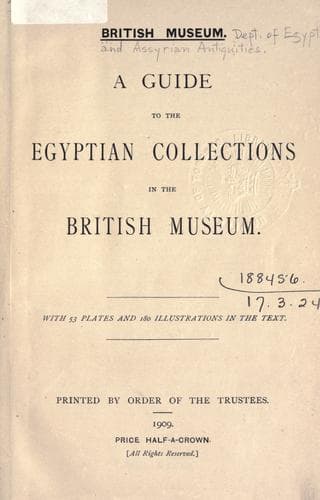
A guide to the Egyptian collections in the British MuseumBritish Museum. Department of Egyptian and Assyrian Antiquities
History
A guide to the Egyptian collections in the British Museum
British Museum. Department of Egyptian and Assyrian Antiquities
Egypt -- Antiquities
In connection with the adoration of the Nile, two important =festivals=
were observed. The first of these took place in June and was called
the “Night of the Tear,” 𓈖𓇉𓄿𓏏𓏲𓏭𓇌𓁻, _Qerḥ en Ḥatui_, because it was
believed that at this time of the year the goddess Isis shed tears in
commemoration of her first great lamentation over the dead body of her
husband Osiris. Her tears fell into the river, and as they fell they
multiplied and filled the river, and in this way caused the Inundation.
This belief exists in Egypt, in a modified form, at the present time,
and, up to the middle of last century the Muḥammadans celebrated, with
great solemnity, a festival on the 11th day of Paoni (June 17th), which
was called the “Night of the Drop,” _Lêlat al-Nuḳtah_. On the night of
this day a miraculous drop of water was supposed to fall into the Nile
and cause it to rise. The second ancient Nile-festival was observed about
the middle of August, and has its equivalent in the modern Muḥammadan
festival of the “Cutting of the Dam.” A dam of earth about 23 feet high
was built in the Khalîg Canal, and when the level of the Nile nearly
reached this height, a party of workmen thinned the upper portion of the
dam at sunrise on the day following the “completion of the Nile,” and
immediately afterwards a boat was rowed against it, and, breaking the
dam, passed through it with the current.
The history of Egypt shows that in all periods the country has suffered
from severe =famines=, which have been caused by successions of “low”
Niles. Thus a terrible seven years’ famine began in A.D. 1066, and lasted
till 1072. Dogs, cats, horses, mules, vermin fetched extravagant prices,
and the people of Cairo killed and ate each other, and human flesh was
sold in the public markets. In Genesis xli, we have another example
of a seven years’ famine, and still an older one is mentioned in an
inscription cut upon a rock on the Island of Sâḥal in the First Cataract.
According to the text, this famine took place in the reign of Tcheser,
a king of the IIIrd dynasty, about B.C. 4000, because there had been no
satisfactory inundation of the Nile for seven years. The king says that
by reason of this, grain was very scarce, vegetables and garden produce
of every description could not be obtained, the people had nothing to
eat, and men were everywhere robbing their neighbours. Children wailed
for food, young men had no strength to move, strong men collapsed for
want of sustenance, and the aged lay in despair on the ground waiting
for death. The king wrote to Matar, the Governor of the First Cataract,
where the Nile was believed to rise, and asked him to enquire of Khnemu,
the god of the Cataract, why such calamities were allowed to fall on the
country. Subsequently the king visited Elephantine, and was received by
Khnemu, the god of the Cataract, who told him that the Nile had failed to
rise because the worship of the gods of the Cataract had been neglected.
Public-domain text, read in full here on John Shaqi.
Reviews
Reviews
No reviews yet
Be the first to share your thoughts on this work.
Join the Discussion
Join the discussion
Sign in to leave a comment or review.
Sign InorCreate an account