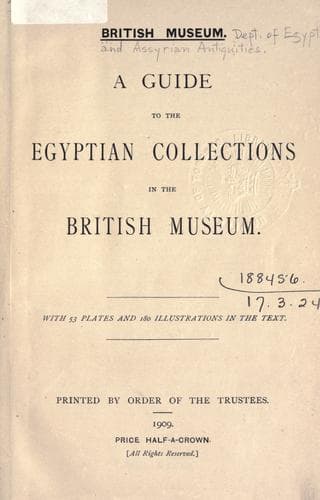
A guide to the Egyptian collections in the British MuseumBritish Museum. Department of Egyptian and Assyrian Antiquities
History
A guide to the Egyptian collections in the British Museum
British Museum. Department of Egyptian and Assyrian Antiquities
Egypt -- Antiquities
To the period of the XIth dynasty may be attributed the following
interesting tablets and reliefs: Relief, from the tomb of =Sebek-āa= at
Ḳurnah (see =Plate XXIII=), on which are represented the preparations for
a funeral feast, the figure of the deceased lying on his bier, etc. (Bay
4, No. =120=). The cutting of the figures and design is of a most unusual
character; and for the general treatment of the subject this stele is
probably unique. Other tablets, probably somewhat later in date, are:
Tablet of =Khensu-user=, set up by his son Seḥetep-ȧb (Bay 3, No. =121=),
tablet of =Sa-Menthu= (Bay 2, No. =122=), tablet of =Menthu-ḥetep=
(Vestibule, North Wall, No. =123=), and tablet of =Mer-shesu-Ḥeru= and
his friends (Bay 2, No. =124=). The portion of a wooden coffin inscribed
in hieratic with part of the =XVIIth Chapter= of the Book of the Dead,
in Wall-case 87 in the Second Egyptian Room, belongs to this period; the
text was written for one of the =Menthu-ḥetep= kings.
During the reign of =Sānkh-ka-Rā Menthu-ḥetep=, who was probably the
last king of the dynasty, an expedition, under the command of a general,
Ḥennu, was despatched to =Punt=, by way of the Red Sea. The object of
the expedition was to obtain a supply of =ānti= 𓂝𓈖𓅂𓈒𓏦, or =myrrh=,
which was largely used for purposes of embalming. Ḥennu succeeded in
reaching Punt, and in bringing back large quantities of all the products
of that remote country. Details of the reign of Sānkh-ka-Rā are wanting,
but with, or soon after, his death the XIth dynasty and the Ancient
Empire came to an end. The length of the period which elapsed between the
close of the VIth and the close of the XIth dynasty is unknown. Some
authorities make the interval between the VIth and the XIIth dynasty to
be about 650 years, others less than 500 years, and others less still.
The following monuments probably belong to the period which immediately
preceded the rise to supreme power of Ȧmenemḥāt I, the first king
of the XIIth dynasty: Black granite seated statue of =Menthu-āa=, or
=Āa-Menthu=, an Erpā and Ḥā Prince, son of the lady Mert (Vestibule, No.
=127=); tablet of the lady =Nefert-tu=, set up in her honour by her son
Menthu-ḥetep (Bay 1, No. =128=), and the tablets of =User= (Bay 1, No.
=129=), and =Ȧqer= (Bay 1, No. =130=). The tablet of =Ȧntef=, son of the
lady Qeḥet, or Ḥeqt, and overseer of the king’s cattle and preserves
of water fowl (Vestibule, No. =133=), and the important inscription of
=Ȧntef=, the son of the lady Mait (Bay 4, No. =134=), and the Prayer of
=N-Ȧntef-ȧqer= to Ȧnpu, lord of Sepau (Vestibule, No. =135=), are all
interesting, and are characteristic productions of this period.
CHAPTER XI.
MIDDLE EMPIRE.
Twelfth Dynasty. From Thebes.
_About_ B.C. 2466.
[Sidenote: B.C. 2466.]
Public-domain text, read in full here on John Shaqi.
Reviews
Reviews
No reviews yet
Be the first to share your thoughts on this work.
Elsewhere in the archive
Join the Discussion
Join the discussion
Sign in to leave a comment or review.
Sign InorCreate an account