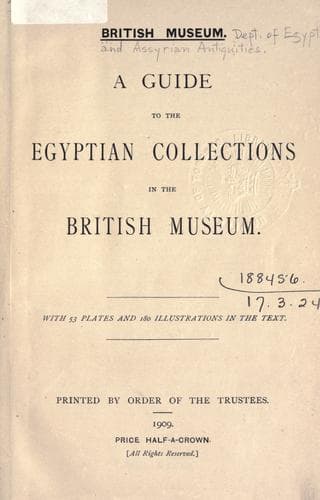
A guide to the Egyptian collections in the British MuseumBritish Museum. Department of Egyptian and Assyrian Antiquities
History
A guide to the Egyptian collections in the British Museum
British Museum. Department of Egyptian and Assyrian Antiquities
Egypt -- Antiquities
Foremost among the monuments of this reign must be mentioned the colossal
grey granite seated statue, and the head, which probably belongs to it,
exhibited in the Southern Egyptian Gallery (Bay 22, Nos. =774=, =775=;
see =Plate XXVI=). The inscription on the pedestal of the throne was cut
there by order of Uasarken II, a king of the XXIInd dynasty; but it is
certain that an earlier inscription existed, which was erased to make
room for the new one. The features of the face and the general treatment
of the head resemble those of all other extant inscribed statues and
figures of Ȧmenemḥāt III; compare the cast of the statue in the Hermitage
at St. Petersburg (Bay 2, No. =172=), and the cast of a head from a
statue of the king (No. 172, in Wall-case 101, in the Third Egyptian
Room). To his reign also belong the famous =sphinxes= which were found at
Ṣân (Tanis) in 1861, and were for many years attributed to the Hyksos,
because the name of Ȧpepȧ was cut on a shoulder of one of them. On the
cast of one of these exhibited in the Central Saloon (No. =173=) are
inscribed cartouches of Rameses II, Mer-en-Ptaḥ II, and Pasebkhānut. Of
officials who flourished in this reign we have the fine white limestone
=shrine of Pa-suten-sa=, from Mêdûm, surmounted by the figure of a hawk
(Bay 1, No. =174=); the stele of =Nebpu-Usertsen=, one of the king’s
personal attendants (Bay 2, No. 175); the stele of =Usertsen-senbu=
𓄊𓋴𓂋𓏏𓊃𓈖𓋴𓈖𓃀𓋴𓈖𓃀𓋴𓈖𓃀, a veritable royal kinsman, and a commissioner
of the revenue, dated in the 25th year of the king’s reign (Bay 1, No.
=177=); and the =stele and altar of Sebek-ḥer-ḥeb= and =Kemen=, dated in
the 44th year of the king’s reign[32] (Bay 3, Nos. =179=, =180=). The
stele of =Tati-ānkef= (Bay 5, No. =181=), the son of =Tenȧuit=, is of
peculiar interest, for it was found in Malta (see page 220).
[Illustration: PLATE XXVI.
Head of a colossal seated statue of Ȧmenemḥāt III (?), B.C. 2300.
[Southern Egyptian Gallery, Bay 22, No. 774.]]
The reign of =Ȧmenemḥāt IV= was short, and monuments of his reign are
few. His name is found on the rocks in the copper mines in Sinai, and
on a rock at Kummah in Nubia, but details of his reign are wanting. An
interesting glazed steatite plaque, bearing his name and that of =Prince
Ȧmeni=, will be found in Wall-case 150 in the Fourth Egyptian Room, No. 1.
[Illustration: Shrine dedicated to Osiris by Pa-suten-sa, scribe, who
flourished in the reign of Ȧmenemḥāt III, B.C. 2300.
[Northern Egyptian Gallery, Bay 1, No. 174.]]
The last ruler of this dynasty was =Sebek-neferut-Rā=, the Skemiophris
of Manetho, and sister of Ȧmenemḥāt IV; her reign was short, and her
monuments are few. The most important is the glazed =cylinder-seal=
inscribed with four of her royal names, exhibited in Table-case D, Fourth
Egyptian Room, No. =134=.
Public-domain text, read in full here on John Shaqi.
Reviews
Reviews
No reviews yet
Be the first to share your thoughts on this work.
Elsewhere in the archive
Join the Discussion
Join the discussion
Sign in to leave a comment or review.
Sign InorCreate an account