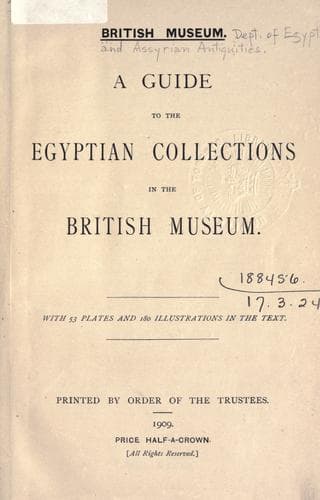
A guide to the Egyptian collections in the British MuseumBritish Museum. Department of Egyptian and Assyrian Antiquities
History
A guide to the Egyptian collections in the British Museum
British Museum. Department of Egyptian and Assyrian Antiquities
Egypt -- Antiquities
In connexion with the XIIth dynasty must be mentioned King =Ḥer=, who may
have been a son of Ȧmenemḥāt III, or of Usertsen III (see his scarab,
No. 37,652), and an Usertsen with the prenomen of =Seneferȧb-Rā=, who is
sometimes called =Usertsen IV=.
[Illustration: Sepulchral stele of Tatiankef, the son of Tenȧuit. Found
in Malta.
XIIth dynasty.
[Northern Egyptian Gallery, Bay 5, No. 181.]]
The rule of the XIIth dynasty was long and prosperous; and art, and
sculpture, and literature flourished. The art of the period is developed
directly out of that of the Ancient Empire, but one of the most prominent
characteristics is an increased tendency towards realism which is
especially seen in the designs and workmanship of small objects. The
=Scarabs= of the XIIth dynasty are particularly interesting and
beautiful, and a splendid set of examples is exhibited in the Fourth
Egyptian Room. The =sepulchral stelae= of the period are also very
interesting, and many of them exhibit clearly the transition stages
between the “false door” of the maṣṭaba tomb of the Ancient Empire and
the stele, or tablet, which stood by itself in the tomb. The British
Museum Collection is rich in XIIth dynasty stelae, comprising examples of
every important variety. The inscriptions upon them usually open with the
formula =suten-ṭā-ḥetep=, 𓇓𓏙𓊵𓏏𓊪 which is followed by a prayer to one
or more gods for sepulchral offerings and for “glory in heaven, strength
upon earth, and triumph in the Other World.” Opinions differ as to the
meaning of the formula _suten ṭā ḥetep_. Some think that it is a prayer
to “the king to give an offering”; and others that it is a prayer for
“an offering like that of a king”; and many different renderings have
been proposed by Egyptologists. It is of course possible that, under the
IVth dynasty, the formula may have been a prayer that an offering might
be given by the king, for the king was regarded as the equal of Anubis
and Osiris and other gods of the dead; but it is manifestly impossible
that every man throughout Egypt could expect the king to send him an
offering at his death, and we are therefore driven to conclude that the
original meaning of the formula was forgotten at a very early period, and
that it was only prefixed to funerary texts at the dictates of custom
or tradition. If it had any meaning at all in the later dynasties, it
would probably be that of a petition to one or more gods for the gift of
an offering like unto that made for a king after his death. Sepulchral
stelae are also valuable because they give the titles of the offices held
by deceased persons, and because they often supply biographies of men who
played important parts in the history of their country.
Public-domain text, read in full here on John Shaqi.
Reviews
Reviews
No reviews yet
Be the first to share your thoughts on this work.
Elsewhere in the archive
Join the Discussion
Join the discussion
Sign in to leave a comment or review.
Sign InorCreate an account