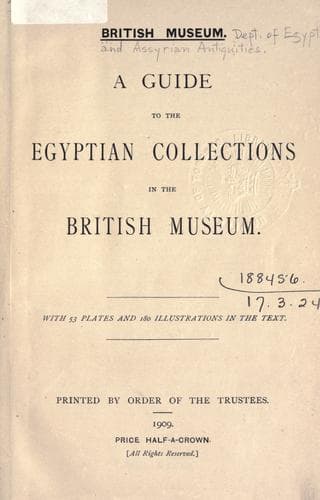
A guide to the Egyptian collections in the British MuseumBritish Museum. Department of Egyptian and Assyrian Antiquities
History
A guide to the Egyptian collections in the British Museum
British Museum. Department of Egyptian and Assyrian Antiquities
Egypt -- Antiquities
Among stelae and other monuments of historical value of this period
may be mentioned: Stele from the tomb of =Khnemu-ḥetep= at Beni-Hasan
(Vestibule, No. =182=); statue of =Ȧmenemḥāt=, a veritable royal
kinsman,[33] and =master= of =the robes= (Bay 1, No. =183=); seated
figure of =Ȧmeni=, inscribed with a prayer for offerings (Bay 1, No.
=184=); stele of =Nekhtȧ=, a Ḥā Prince (Bay 1, No. =185=); stele of
=Ȧnḥer-nekht=, =chief clerk= of =grain supply= (Bay 1, No. =186=);
stele of =Ȧntef=, an overseer of priests (Bay 1, No. =187=); stele of
=Sa-Ȧnḥer=, a deputy keeper of the seal, with figures of eighteen of his
children and relatives bearing offerings (Bay 1, No. =189=); stele of the
lady =Khu=, with figures of her two husbands and twelve children (Bay 1,
No. =190=); stele set up to =the memory= of =sixteen persons= and their
mothers (Bay 2, No. =191=); stele of =Sebek-āāiu=, with hieroglyphics
inlaid with blue paste (Bay 2, No. =193=); stele of =Ȧmeni=, of unusual
style (Bay 2, No. =194=); stele of =Erṭā-Ȧntef-Ṭāṭāu=, a governor of the
Sûdân (Bay 4, No. =196=); and stele of =Ȧntef=, with an inscription of
twenty lines in which the deceased describes his virtues and abilities
(Bay 7, No. =197=). As examples of the wall-paintings on the tombs of
this period may be mentioned the slabs from the tomb of =Teḥuti-ḥetep=,
a high official who flourished during the reign of Ȧmenemḥāt II (Bay
2, Nos. =198-200=; Bay 7, No. =201=). To the same period, or a little
later, belongs the sandstone =obelisk= which was set up to the memory
of an Egyptian official of the copper mines at Ṣarâbît al-Khâdim in the
Peninsula of Sinai (Bay 1, No. =202=).
The other monuments of the XIIth dynasty consist of =altars=, or =tablets
for offerings=, of which a considerable number are exhibited in =Bays 14,
16, and 17=. Among the altars of the XIIth dynasty may be noted that of
the Ḥā prince =Usertsen=, a superintendent of the prophets, sculptured
with figures of vases and two tanks, and inscribed with an address to
the living (Bay 17, No. =269=). The altar is a rectangular, flat slab of
stone, with a projection which was intended to serve as a spout, from
which the drink offerings were supposed to run off into a vessel placed
to receive them. In the altar small rectangular tanks were sometimes cut,
but usually the surface was sculptured with figures of haunches of meat,
bread-cakes, fruit, flowers, unguent vases, libation jars, etc., and on
the edges and sides were inscribed prayers for funerary offerings of
meat and drink and for things which were deemed necessary for the dead.
The Egyptians believed that the material things placed on such altars
possessed, like animated creatures, two bodies and spirits; their bodies
were consumed by the priests and others, and their spirits by the gods.
Some believed in the transmutation of offerings.
Public-domain text, read in full here on John Shaqi.
Reviews
Reviews
No reviews yet
Be the first to share your thoughts on this work.
Elsewhere in the archive
Join the Discussion
Join the discussion
Sign in to leave a comment or review.
Sign InorCreate an account