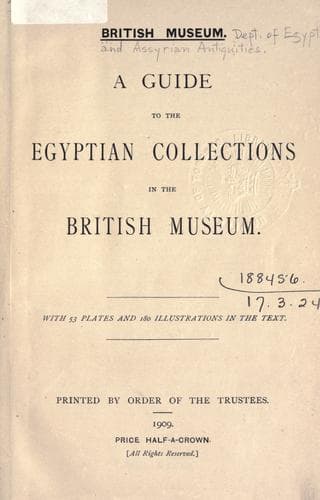
A guide to the Egyptian collections in the British MuseumBritish Museum. Department of Egyptian and Assyrian Antiquities
History
A guide to the Egyptian collections in the British Museum
British Museum. Department of Egyptian and Assyrian Antiquities
Egypt -- Antiquities
The reign of Ȧmen-ḥetep III was long and prosperous, and his kingdom
extended from the city of Nî, on the Euphrates, to Karei, in the Sûdân.
He developed the gold mines of the Sûdân to an unprecedented extent,
and exported gold to the countries of Western Asia. The monuments of
this reign are numerous; among them may be specially mentioned: =1.=
A tablet inscribed with an account of the crushing of the =revolt in
Nubia= in the fifth year of his reign, set up by =Meri-mes=, governor
of the Sûdân (Bay 6, No. =411=). =2.= Two colossal =seated statues of
Ȧmen-ḥetep III= (see =Plate XXXII=), from the Memnonium (Bay 8, No.
=412=; Bay 9, No. =413=). =3.= Upper portion of a colossal statue (Bay
6, No. =415=), and two heads from colossal sandstone statues of the
king (Bay 4, No. =416=; Bay 5, No. =417=). =4.= Head from the granite
=sarcophagus= of the king (Central Saloon, No. =418=). 5. Grey =granite
column= from a temple built by him at Memphis (?). It was repaired
by =Menephthah I= under the XIXth dynasty, and about 100 years later
=Set-nekht= inscribed his cartouches upon it (Bay 7, No. =419=). The
monuments of his officials are also numerous. The most interesting are:
=Granite coffin of Meri-mes=, governor of the Sûdân (Bay 12, No. =420=);
stele of =Sururu=, a high official (Bay 7, No. =422=), seated figure of
=Kames=, a =king’s messenger= (Bay 5, No. =423=); a slab, with cornice,
from the tomb of =Pa-ȧri=, an overseer of the granaries of Ȧmen-Rā
at Thebes (Bay 10, No. =424=); stele of =Ȧpni=, a master of transport
(Bay 11, No. =425=); painted statue of =Pa-ser=, an Erpā, from Dêr
al-Baḥarî (Bay 13, No. =427=); granite statue of =Ȧmen-ḥetep=, an Erpā,
from Bubastis (Bay 12, No. =428=), etc. Of special interest are the two
fine =red granite lions=, which were found in the ruins of a temple at
Gebel Barkal, at the foot of the Fourth Cataract. No. =430= dates from
the reign of Ȧmen-ḥetep III, and appears to have been made by him for
the temple of Ṣulb; No. =431= was, according to the inscription, made
by =Tut-ānkh-Ȧmen=, a later king of the XVIIIth dynasty, who “repaired
the monuments of his father Ȧmen-ḥetep” (see =Plate XXXVI=). The name
of a late Nubian king, =Ȧmen-Ȧsru=, is found on each lion, and it is
possible that he may have brought both lions to Napata from Ṣulb, and
placed them in his own temple. Stelae Nos. =432= (Bay 10) and =433= (Bay
9) are of a most unusual character. No. 432 is a late (Ptolemaïc) copy,
written in hieratic, of the =deed of endowment= of the funerary chapel
of =Ȧmen-ḥetep, the son of Ḥāp=, the famous architect who built the
=Colossi=, dated in the thirty-first year of the reign of Ȧmen-ḥetep III.
No. 433 is inscribed with a series of addresses which can be read both
perpendicularly and horizontally. Among smaller objects inscribed with
the names of Ȧmen-ḥetep III and Queen Thi may be noted the bronze =menȧt
amulet=, stamp, vase, =brick=, =stibium pot=, plaque, =scarabs=, etc.,
Public-domain text, read in full here on John Shaqi.
Reviews
Reviews
No reviews yet
Be the first to share your thoughts on this work.
Elsewhere in the archive
Join the Discussion
Join the discussion
Sign in to leave a comment or review.
Sign InorCreate an account