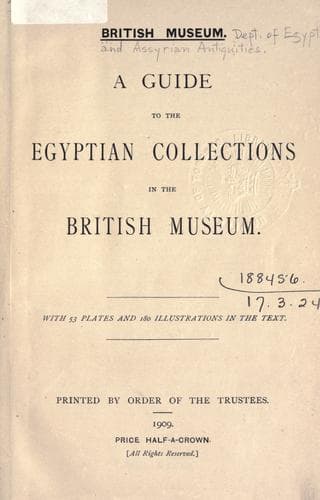
A guide to the Egyptian collections in the British MuseumBritish Museum. Department of Egyptian and Assyrian Antiquities
History
A guide to the Egyptian collections in the British Museum
British Museum. Department of Egyptian and Assyrian Antiquities
Egypt -- Antiquities
which are exhibited in the Third and Fourth Egyptian Rooms.
[Illustration: Scarab of Ȧmen-ḥetep III, recording the names of the
parents of Queen Thi.
[No. 29,437.]
Scarab of Ȧmen-ḥetep III, recording the slaughter of 102 lions by the
king in the first ten years of his reign.
[No. 12,520.]]
Of the greatest importance for the history of this reign are the =Tell
al-Amarna Tablets=, a fine collection of which is exhibited in Table-case
=F= in the Babylonian Room. They consist of a series of letters and
despatches, etc., written chiefly to Ȧmen-ḥetep III and his son
Ȧmen-ḥetep IV, by kings and governors of countries, provinces, and towns
in Western Asia. Nearly all are written in a Semitic dialect, and in the
cuneiform character. They were found in a chamber to the east of the
palace of Ȧmen-ḥetep IV, in the city of Khut-Ȧten, near the modern Tell
al-Amarna. Among the =royal letters= in the British Museum are: =Draft=
of a letter from =Ȧmen-ḥetep III to Kadashman-Bêl=, king of Karaduniyash
(No. 29,784); a letter from =Kadashman-Bêl to Ȧmen-ḥetep III= (No.
29,787); letters from =Tushratta=, king of Mitani, to Ȧmen-ḥetep III
(Nos. 29,792, 29,791); letter from =Burraburiyash= to Ȧmen-ḥetep IV (No.
29,785); letter from =Tushratta to Thi=, queen of Egypt (No. 29,794);
etc.[37] (see =Plates XXXIV=, =XXXV=).
[Sidenote: B.C. 1400.]
=Ȧmen-ḥetep IV= was the son of Ȧmen-ḥetep III and Queen Thi, and reigned
about 20 years. In his youth he became a warm devotee of the god =Ȧten=,
whose visible symbol was the solar disc, and rejected the cult of Ȧmen,
or Ȧmen-Rā, the king of the gods. During the first few years of his
reign he lived at Thebes, and built there a Benben 𓃀𓈖𓃀𓈖𓉐, or shrine,
dedicated to Harmachis; and it seems that this was regarded by the
priests with disfavour. The pretensions of the priests of Ȧmen were
unbearable to him, and he therefore decided to leave Thebes and build a
royal capital elsewhere. The site chosen by him was on the east bank of
the Nile, near the modern villages of Ḥaggi Ḳandîl and Tell al-Amarna.
There he built a temple to Ȧten, a palace for himself, and houses for his
officials. As the new capital grew, so the enmity between the king and
the priests of Ȧmen increased. This can hardly be wondered at, for he
caused the name and representations of the god to be obliterated from the
monuments. Having moved to his new city, which he called =Khut-Ȧten=, he
abandoned his name of Ȧmen-ḥetep, because it contained the name of the
god he despised, and adopted the new name of =Khu-en-Ȧten=, _i.e._, the
“Spirit of Ȧten.” In his new capital he established a new form of the
ancient =cult of Ȧten=, as he understood it, in the temple Ḥet-Benben;
and the new worship was carried on with the forms and ceremonies which
had been in use in Heliopolis for some two thousand years. Incense was
burnt on the altars, offerings of all kinds were made, but no bloody
sacrifices were offered up; on certain occasions the king himself
officiated.
Public-domain text, read in full here on John Shaqi.
Reviews
Reviews
No reviews yet
Be the first to share your thoughts on this work.
Elsewhere in the archive
Join the Discussion
Join the discussion
Sign in to leave a comment or review.
Sign InorCreate an account