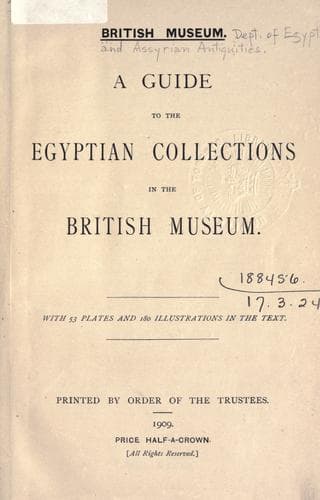
A guide to the Egyptian collections in the British MuseumBritish Museum. Department of Egyptian and Assyrian Antiquities
History
A guide to the Egyptian collections in the British Museum
British Museum. Department of Egyptian and Assyrian Antiquities
Egypt -- Antiquities
The =followers of Ȧten= declared that their god was almighty;
and that he was the =sole creator= of the universe; they ascribed to him
a =monotheistic character=, or oneness, =which denied the existence of
any other god=. Their god was “One Alone,” and different in nature from
any of the other gods of Egypt. It was the =intolerance= of the followers
of the cult of Ȧten as formulated by Ȧmen-ḥetep IV which made them hated
by the priests of Ȧmen-Rā at Thebes.
[Illustration: PLATE XXXIV.
Letter from Ȧmen-ḥetep III, king of Egypt, to Kadashman-Bêl, king of
Karaduniyash.
[No. 1, Table-case F, Babylonian and Assyrian Room.]]
[Illustration: PLATE XXXV.
Letter from Tushratta, king of Mitani, to Ȧmen-ḥetep III, king of Egypt.
[No. 8, Table-case F, Babylonian and Assyrian Room.]]
The palace and houses of the new city were beautiful, and were richly
decorated. Art developed in a new direction, and was characterized by a
freedom and a naturalism which are never met with, before or after, in
Egyptian history. It sanctioned the use of new colours and new designs.
The reliefs and pictures of the king prove that his features were unusual
in character. He had a high, narrow, receding forehead, a large aquiline
nose, a thin mouth, projecting chin, a slender neck, rounded chest, and
his figure in many respects resembled that of a woman (see Wall-case 105,
Third Egyptian Room, Nos. =213= and =214=). Whilst the king was playing
the priest in his new city, and making arrangements for building shrines
to Ȧten in the Sûdân, his Asiatic Empire was breaking up. The Tell
al-Amarna letters show how rapidly the desert tribes began to harass the
Egyptian garrisons in Syria and Palestine, and to hem them in. Ȧmen-ḥetep
IV made no attempt to maintain his authority in Asia, or to keep what
his fathers had won in battle, and there is no record of any military
expedition during his reign. Shortly after his death Egypt had lost her
Asiatic Empire, his new city was destroyed, the cult of Ȧten died out,
and the shrine of Harmachis which he built at Thebes was pulled down,
and the stones rebuilt into the temple of Ȧmen. Ȧmen and his priests had
prevailed.
Among the monuments of this reign may be mentioned: =1.= Base of a
=statue= of =Ȧmen-ḥetep IV=, inscribed with the names and titles of
Khu-en-Ȧten; his cartouche as Ȧmen-ḥetep IV has been mutilated (Bay 13,
No. =435=). =2.= Base of a statue inscribed with the names of Khu-en-Ȧten
and his wife =Nefertith= (Bay 13, No. =436=). =3.= Stele of =Ptaḥ-māi=,
inscribed with prayers to Ȧten and Rā (Bay 10, No. =438=). The Tell
al-Amarna letters to Ȧmen-ḥetep IV will be found in Table-case F in the
Babylonian Room; the =scarabs=, =rings=, etc., in Table-cases D and J;
and a fine porcelain =boomerang= in Wall-case 150, in the Fourth Egyptian
Room. (For a rough outline drawing of Queen Nefertith (?) see Table-case
C in the Third Egyptian Room, No. 4.)
Public-domain text, read in full here on John Shaqi.
Reviews
Reviews
No reviews yet
Be the first to share your thoughts on this work.
Elsewhere in the archive
Join the Discussion
Join the discussion
Sign in to leave a comment or review.
Sign InorCreate an account