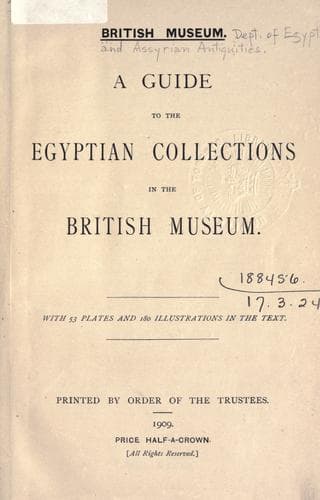
A guide to the Egyptian collections in the British MuseumBritish Museum. Department of Egyptian and Assyrian Antiquities
History
A guide to the Egyptian collections in the British Museum
British Museum. Department of Egyptian and Assyrian Antiquities
Egypt -- Antiquities
The last kings of this dynasty were =Tut-ānkh-Ȧmen=, =Ȧi=, and
=Ḥeru-em-ḥeb=; the first two of these married members of the family of
Ȧmen-ḥetep IV. Ḥeru-em-ḥeb was a wise and just king, and his reign was
long and prosperous. Of the monuments of these reigns may be mentioned:
the red =granite lion= inscribed with the name of Tut-ānkh-Ȧmen (Bay 10,
No. =431=; see =Plate XXXVI=); the stele of =Thuthu=, a steward of Ȧi
(Bay 12, No. =439=); the granite =statue of Ḥeru-em-ḥeb= (Bay 13, No.
=441=), and the statues of Ḥeru-em-ḥeb and the =god Menu=, or Ȧmsu (Bay
12, No. =442=); the =stibium tube= of Tut-ānkh-Ȧmen and his wife Queen
Ānkh-sen-Ȧmen (Wall-case 183, Fourth Egyptian Room, No. 23).
[Illustration: PLATE XXXVI.
Granite lion dedicated to Ȧmen-ḥetep III by Tut-ānkh-Ȧmen, about B.C.
1400.
[Northern Egyptian Gallery, Bay 10, No. 431.]]
[Illustration: PLATE XXXVII.
Seated statues of a priest, or high official, and his wife.
XVIIIth or XIXth dynasty.
[Southern Egyptian Gallery, Bay 18, No. 565.]]
The statues, stelae, etc., of the XVIIIth dynasty are numerous, and
many of them are of great interest as illustrating the perfection to
which art attained under the patronage of wealthy kings and the priests
of Ȧmen. Among them may be noted the following: Figure and stele
of =Nekht-Menu= or Nekht-Ȧmsu, holding a stele (Bay 2, No. =443=);
figures of =Ȧri-neferu= and his wife =Ȧpu= (Bay 3, No. =444=); stele of
=Ȧmen-em-ḥāt=, inscribed with adorations to Osiris (Bay 5, No =447=);
granite figure of =Kamesu=, a scribe (Bay 7, No. =452=); stele of
=Pasheṭ=, guardian of the northern lake and northern pillars of Ȧmen
(Bay 8, No. =455=); stele of =Nefer-renpit=, sculptured with a scene
representing the ceremony of Opening the Mouth (Bay 8, No. =456=); stele
of =Teḥutimes=, captain of the guard of the city gate of Memphis (Bay 8,
No. =460=); stele of =Ḥeru-em-ḥeb= a high official, and two door-jambs
inscribed with a hymn to the Sun-god (Bay 8, Nos. =461-463=); stele of
=Neb-Rā=, on which are sculptured four eyes and two ears 𓁻𓁻𓁻𓁻𓄔𓄔 (Bay
9, No. =467=); stele of =Ban-āa=, a royal scribe (Bay 9, No. =474=);
stele of =Ḥeru= and =Sutui=, twin brothers, architects and clerks of the
works at Thebes early in the XVIIIth dynasty (Bay 9, No. =475=); stele of
=Pasheṭ= inscribed with praises of the Syrian god =Reshpu= (Bay 10, No.
=478=); stele of =Qaḥa= (Bay 10, No. =483=); stele of =Māḥu=, captain of
the king’s bow (Bay 10, No. =487=); stele of =Anna= (Bay 11, No. =503=);
stele of =Sebek-ḥetep=, scribe of the wine-cellar (Bay 12, No. =513=);
sepulchral monument of =Thuthu=, with pyramidal top and libation basin
attached (Bay 13, No. =549=); granite figure of =Qen-nefer=, a high court
official (Central Saloon, No. =556=); three small inscribed =pyramids=
(Bay 18, Nos. =558-560=); painted =shrine of Ani=, a gardener (Bay 18,
No. =561=), etc. To the period of the XVIIIth dynasty may probably
be attributed the seated statues of a priest, or high administrative
Public-domain text, read in full here on John Shaqi.
Reviews
Reviews
No reviews yet
Be the first to share your thoughts on this work.
Elsewhere in the archive
Join the Discussion
Join the discussion
Sign in to leave a comment or review.
Sign InorCreate an account