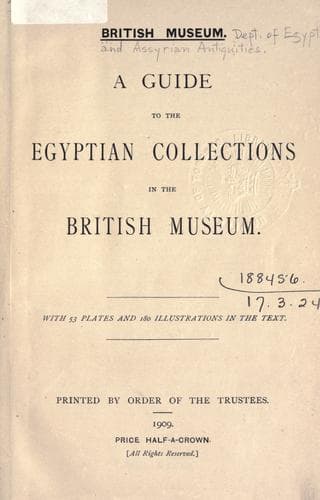
A guide to the Egyptian collections in the British Museum — John Shaqi
A guide to the Egyptian collections in the British MuseumBritish Museum. Department of Egyptian and Assyrian Antiquities
History
A guide to the Egyptian collections in the British Museum
British Museum. Department of Egyptian and Assyrian Antiquities
Egypt -- Antiquities
1. =Peḥ-Qennes.= The region south of Meroë.
2. =Maruat.= Meroë. Bagrawîr. Ȧmen.
3. =Napt.= Napata. Ȧmen.
4. =Peten-Ḥeru.= Pontyris. Horus.
5. =Pa-Nebset.= Pnups. Thoth.
6. =Ta-Uatchet.= Autoba (?).
7. =Behent.= Boôn. Wâdî Ḥalfah. Horus.
8. =Ȧtefthit.= Tasitia (?).
9. =Nehȧu.= Noa.
10. =Meḥit.= Meae. Horus.
11. =Maamet.= Ibrîm. Horus.
12. =Bekt.= Bok. Kubbân. Horus.
13. =Ḥet-Khent.= P-ȧlek. Philae. Bilâk. Isis.
Under the Ptolemies, the district between Elephantine and Philae was
called =Dodekaschoinos=, because it contained twelve schoinoi, or
measures of land, but later this term was applied to the whole region
between Elephantine and Hiera Sykaminos.
Under the late Roman emperors many of the nomes were subdivided, probably
for convenience in levying taxes, and in still later times the governor
of a nome, or province, bore the title of Duke (Δουξ).
=Modern Egypt= is divided into =14 provinces=:
LOWER EGYPT.
Province. Capital.
1. Baḥêrah. Damanhûr.
2. Ḳalyûbîyah. Benha.
3. Sharkîyah. Zaḳâzîḳ.
4. Dakhâlîyah. Manṣûrah.
5. Manûfîyah. Menûf.
6. Gharbîyah. Ṭanṭa.
UPPER EGYPT.
Province. Capital.
1. Gîzah. Gîzah.
2. Beni-Suwêf. Beni-Suwêf.
3. Minyah. Minyah.
4. Asyûṭ. Asyûṭ.
5. Girgah. Ṣûhâḳ.
6. Ḳena. Ḳena.
7. Nûba. Aswân.
8. Fayyûm. Madînat al-Fayyûm.
The towns of Cairo, Alexandria, Port Sa’îd, Suez, Damietta, etc., are
generally governed each by a native ruler.
The provinces of the Sûdân are as follows:
1. Baḥr al-Ghazâl. 2. Berber. 3. Blue Nile Province. 4. Dongola. 5.
Ḥalfah. 6. Kassala. 7. Kharṭûm Province. 8. Kordofân. 9. Mongalla. 10.
Red Sea Province. 11. Sennaar. 12. Upper Nile Province. 13. White Nile
Province.
CHAPTER II.
ETHNOGRAPHY. THE LAND OF PUNT. NATIONAL CHARACTER. POPULATION. LANGUAGE.
FORMS OF WRITING. DECIPHERMENT OF EGYPTIAN HIEROGLYPHICS. YOUNG AND
CHAMPOLLION. HIEROGLYPHIC ALPHABET AND WRITING. WRITING MATERIALS.
Public-domain text, read in full here on John Shaqi.
Reviews
Reviews
No reviews yet
Be the first to share your thoughts on this work.
Join the Discussion
Join the discussion
Sign in to leave a comment or review.
Sign InorCreate an account