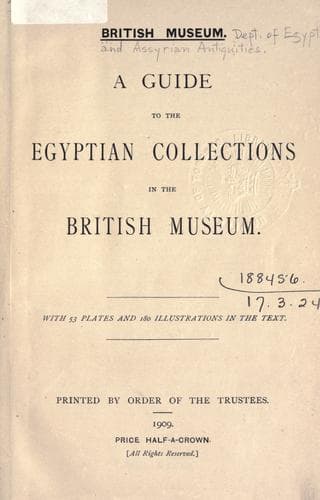
A guide to the Egyptian collections in the British Museum — John Shaqi
A guide to the Egyptian collections in the British MuseumBritish Museum. Department of Egyptian and Assyrian Antiquities
History
A guide to the Egyptian collections in the British Museum
British Museum. Department of Egyptian and Assyrian Antiquities
Egypt -- Antiquities
The =Egyptians=.—The evidence of the monuments and the literature of
Egypt proves that the Egyptians were of African origin, and that they
were akin to the light-skinned peoples who inhabited the north-east
portion of the African Continent. Further evidence of this fact is
supplied by the “table of nations” preserved in the tenth chapter of
Genesis, where it is stated that Cush and Mizraim were the sons of Ham.
Now this Cush, or Ethiopia, is not the country which we call Abyssinia,
but the Northern Sûdân, or Nubia; therefore the Nubians (Cush) and the
Egyptians (Mizraim) were brethren, and they were Hamites, or Africans.
The relationship between the Nubians and the Egyptians is also asserted
by Diodorus, who declared that the Egyptians were descended from a colony
of Ethiopians, _i.e._, Nubians, who had settled in Egypt. And there is
no doubt that from the earliest to the latest times a very close bond
existed between the Northern Nubians and the Egyptians, which manifested
itself in the religion and religious ceremonies of both peoples. The
Cushites were dark in colour, sometimes actually black, but there is no
evidence which proves they were negroes; and the Egyptians were red, or
brown-red, or reddish yellow in colour. On the west of the Nile Valley
lived the fair-skinned Libyans; on the east the remote ancestors of the
Blemmyes and the modern Bîshârî tribes, who were of a light brownish
colour, and on the south, near the Equator, were negro tribes, which
formed part of the great belt of black peoples that extended right across
Africa, from sea to sea.
Public-domain text, read in full here on John Shaqi.
Reviews
Reviews
No reviews yet
Be the first to share your thoughts on this work.
Join the Discussion
Join the discussion
Sign in to leave a comment or review.
Sign InorCreate an account