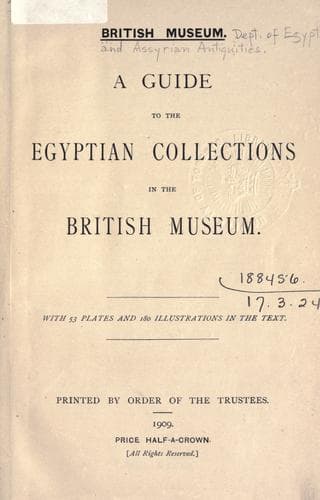
A guide to the Egyptian collections in the British MuseumBritish Museum. Department of Egyptian and Assyrian Antiquities
History
A guide to the Egyptian collections in the British Museum
British Museum. Department of Egyptian and Assyrian Antiquities
Egypt -- Antiquities
It seems that a short time before the reign of Peṭā-Bast, the priests
of Ȧmen had found it impossible to maintain their position at Thebes,
and therefore, having hidden the mummies and coffins of the members of
their order in a secret place, which was not discovered until 1892,
they retreated to the South and settled at Napata, a city at the foot
of the Fourth Cataract. (For examples of the coffins of the priests of
Ȧmen of this period, see First Egyptian Room, Wall-cases 11-15.) A few
years after their arrival, they appear to have persuaded =Piānkhi=, the
king of the Northern Sûdân, to invade Egypt and to seize the kingdom of
the South at least, to which, in view of the close relationship of the
governing powers at Napata with those at Thebes, he might be assumed to
have a just claim. For some time Piānkhi did nothing, but at length, in
the twenty-first year of his reign, hearing that all the princes of the
Northern Kingdom had united their forces, and were attempting to seize
the country, he ordered his army to advance into Egypt. In a very short
time great successes were reported. Thereupon he joined his troops, and
his progress was victorious and rapid. City after city fell before his
attack, and on the capture of Memphis, Egypt lay vanquished at his feet.
The governors came in one after another, and at length Tafnekht, their
leader, sent in his submission accompanied by gifts. Piānkhi filled his
boats with spoil and returned to Napata, where he built a great temple
to Ȧmen, and set up a stele recording his victories. (For a cast of the
stele see Central Saloon, No. =793=.) After Piānkhi’s return to Nubia,
=Osorkon III=, perhaps with =Thekeleth III= as co-regent, reigned at
Thebes. To the latter half of this dynasty probably belongs the stele
of =Prince Ȧuuaruath=, son of Osorkon and high-priest of Ȧmen (Bay 22,
No. =777=), and the monument mentioning a king with the Horus name of
Ka-nekht-khā-em-Uast (Bay 21, No. =778=).
Twenty-Fourth Dynasty. From Saïs.
The principal king of this dynasty was =Bakenrenef=, the =Bocchoris=
of the Greeks, the son of Tafnekht of Saïs. His reign was short, but
tradition assert that he was one of the six great law-givers of Egypt.
About this time a Nubian called =Kashta= ruled at Thebes, and married
=Shep-en-Ȧpt=, the high-priestess of Ȧmen; their son Shabaka became the
first king of the XXVth dynasty. Among the monuments of this period
may be mentioned: The =altar, stand, and libation bowl=, dedicated by
Nes-Ȧmsu to Kashta, Shep-en-Ȧpt, and Ȧmenȧrṭās (Bay 20, No. =794=);
the base of a statue inscribed with the names of =Shep-en-Ȧpt I=,
=Shep-en-Ȧpt II=, etc. (Bay 20, No. =795=); and the alabaster vessel of
=Kashta= and =Ȧmenȧrṭās= (Wall-case 139, Fourth Egyptian Room, No. 84).
Twenty-Fifth Dynasty. From Nubia.
B.C. 700.
Public-domain text, read in full here on John Shaqi.
Reviews
Reviews
No reviews yet
Be the first to share your thoughts on this work.
Elsewhere in the archive
Join the Discussion
Join the discussion
Sign in to leave a comment or review.
Sign InorCreate an account