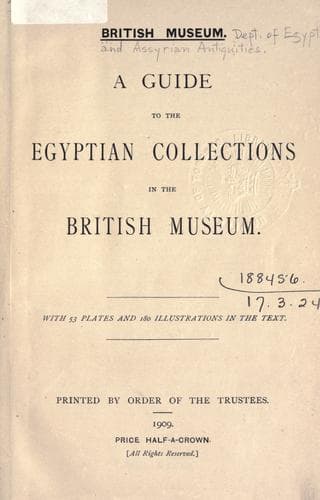
A guide to the Egyptian collections in the British MuseumBritish Museum. Department of Egyptian and Assyrian Antiquities
History
A guide to the Egyptian collections in the British Museum
British Museum. Department of Egyptian and Assyrian Antiquities
Egypt -- Antiquities
The =men of Punt= wore a =pointed beard= and a =loin cloth=, which was
kept in position by a kind of belt, from which hung down behind the
=tail of an animal=. The beard of the Egyptian was also pointed, and
gods, kings, and priestly officials on solemn, ceremonial occasions,
wore tails. Thus in the Papyrus of Ani (Judgment Scene) the gods Thoth
and Anubis wear tails, and the priestly official in the same scene wears
the leopard’s skin, the tail of which is supposed to be hanging behind
him. In two statues of Ȧmen-ḥetep III (Northern Egyptian Gallery, Nos.
412, 413), the tail is supposed to be brought forward under the body of
the king, and its end is carefully sculptured on the space between his
legs. The custom of wearing tails is common in Central Africa at the
present day, even the women, in some places, wearing long tails of bast
(Schweinfurth, _Heart of Africa_, I, p. 295); and a recent traveller
reports that the Gazum people wear tails, about six inches long, for
which they dig holes in the ground when they sit down (Boyd Alexander,
_From the Niger_, I, p. 78). Many other points of comparison between the
Egyptians and the peoples of Central Africa could be mentioned in proof
of the views that the indigenous dynastic Egyptians were connected with
the people of Punt, and that Punt was situated in the South-Eastern Sûdân.
As to the =succession of peoples= in the Nile Valley, or rather of that
portion of it which is called Egypt, many theories have been formulated
in recent years. Some of the most competent authorities think that the
earliest dwellers in Egypt were black folk, who were driven out or killed
off by a race of people who possessed many of the characteristics of the
Libyans, and who came from the west, or south-west, and took possession
of Egypt. It is thought that the next invasions of the country were made
by peoples who came from the east, or south-east, and, having settled
down on the Nile, mingled with the inhabitants. After these it seems
very probable that Egypt was invaded by tribes whose home was some part
of Western Asia, probably the country now called Southern Babylonia.
Some think that they entered Egypt by the Isthmus of Suez, and others
that they crossed from Arabia to Africa by the straits of Bâb al-Mandib
at the southern end of the Red Sea. Another view is that the invaders
entered Egypt by the Wâdî Ḥammâmât, and that they arrived on the Nile at
some place near the modern town of Ḳena. Little by little the invaders
conquered the country, and introduced into it the arts of agriculture,
brick-making, writing, working in metals, etc. Wheat, barley, and the
domestic sheep seem to have been brought into Egypt about this time. The
manners and customs of the new comers were very different from those
of the men they conquered, and their civilization was of a much higher
character than that of the primitive Egyptians; but, among the great
bulk of the population, the beliefs, religion, and habits continued to
Public-domain text, read in full here on John Shaqi.
Reviews
Reviews
No reviews yet
Be the first to share your thoughts on this work.
Join the Discussion
Join the discussion
Sign in to leave a comment or review.
Sign InorCreate an account